


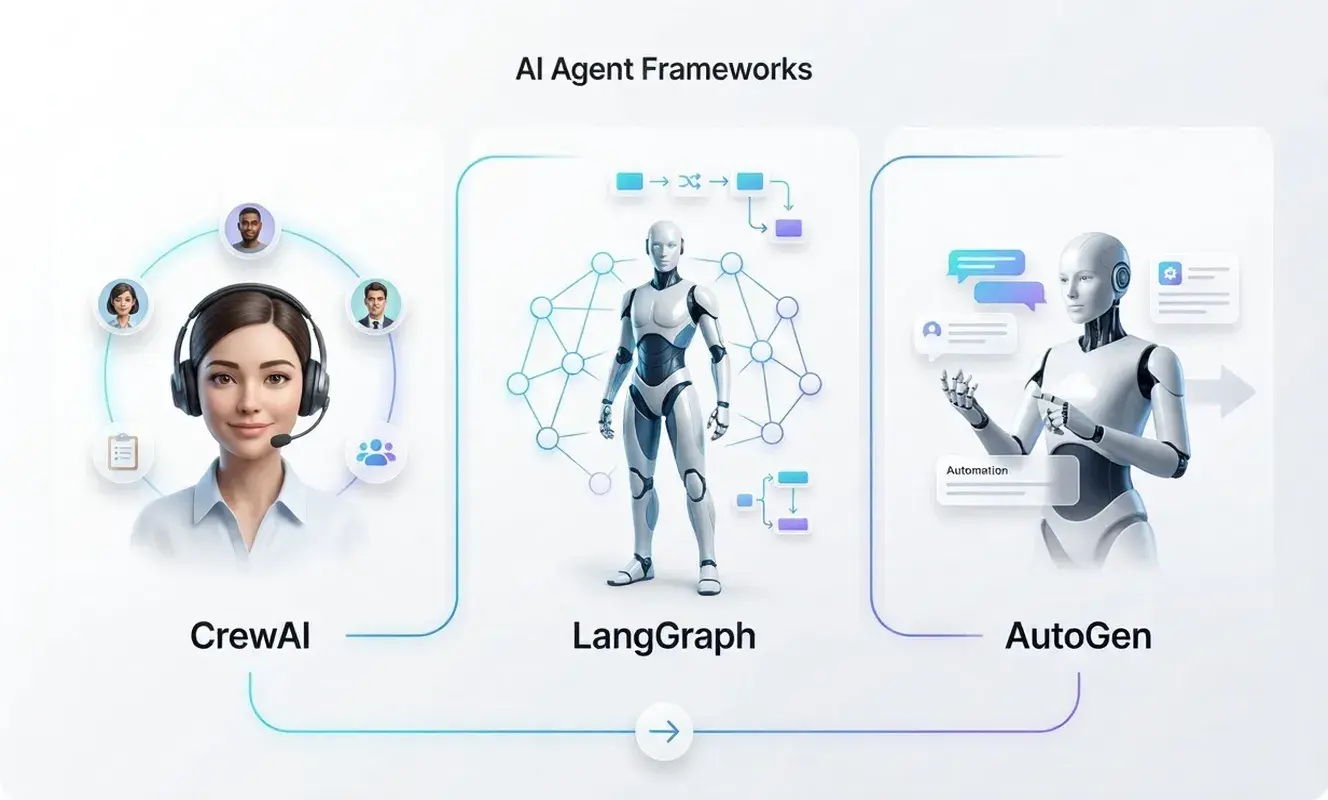
CrewAI vs AutoGen vs LangGraph
An honest, up-to-date breakdown of the three leading AI agent frameworks what changed in 2026, where each excels, and which one fits your use case.
Gaurang Mistry
03 July 2026
If you're building AI agents in 2026, you've probably asked yourself the same question every engineering team is wrestling with right now: Which framework do we actually commit to?
The landscape has shifted dramatically over the past 18 months. What started as a handful of experimental libraries has hardened into production-grade tools with very different philosophies. CrewAI, AutoGen, and LangGraph are the three names that come up most often in architecture discussions but here's the thing: most comparison articles you'll find online are already outdated.
AutoGen entered maintenance mode in October 2025. Microsoft shipped a completely new framework in April 2026. CrewAI crossed 31,000 GitHub stars and launched enterprise tooling. LangGraph hit 1.0 and became the default choice for regulated industries. If you're making a framework decision today, you need facts from mid-2026, not 2024.
This article cuts through the noise. No vendor bias, no affiliate links, no "they're all great" hedging. Just a clear-eyed look at what each framework actually does well, where it falls short, and which one fits your specific use case.
At SaturnCube, we use all three frameworks depending on client needs. Learn more about our AI agent development services.

What Changed in 2026 (And Why Older Comparisons Mislead You)
Before we dive into the frameworks themselves, you need to understand three structural shifts that redefined this space in early 2026.
First, AutoGen is no longer the framework Microsoft recommends. In October 2025, Microsoft moved AutoGen into maintenance mode. The GitHub README now states it directly: "AutoGen is now in maintenance mode. It will not receive new features or enhancements and is community managed going forward." New projects are directed to the Microsoft Agent Framework (MAF), which reached 1.0 GA in April 2026. This means any article that still treats AutoGen as an actively developed Microsoft project is based on outdated information.
Second, LangGraph shipped its 1.0 release in late 2025 and has since become the de facto standard for production agent systems that need audit trails, human approval steps, and state recovery after crashes.
Third, CrewAI commercialized. The open-source core remains free and MIT-licensed, but CrewAI Enterprise now offers hosted execution, observability dashboards, and role-based access control for teams that don't want to self-host.
These three changes fundamentally alter the decision matrix. Let's look at each framework in its current form.
LangGraph: The Production Standard
LangGraph is LangChain's graph-based orchestration layer. It models agent workflows as directed graphs where nodes are functions or agents, edges define transitions, and a typed state object flows through the entire system. Nothing is hidden behind magic abstractions every routing decision is code you wrote and can audit.
What LangGraph Does Exceptionally Well
The standout feature is checkpointing. Every state transition is persisted to a store (SQLite, PostgreSQL, or Redis). If your agent crashes mid-workflow, it resumes from the last checkpoint. If a human needs to approve a transaction before the agent continues, the graph pauses, waits, and resumes exactly where it stopped even if that pause lasts hours or days. This isn't bolted on; it's a first-class primitive.
For teams in regulated industries, this is non-negotiable. A healthcare client processing insurance prior authorizations saw accuracy jump from 71% to 93% after moving to LangGraph, specifically because the graph structure isolated context at the node level and made compliance audits straightforward. Every decision is traceable.
LangGraph also integrates natively with LangSmith for observability. You get distributed tracing, token-level cost tracking, latency histograms, and trace replay. When an agent misbehaves at 2 AM, you can pull up the exact run, inspect every LLM call and tool invocation, and replay it with modified inputs. At enterprise scale, this saves weeks of debugging time.
Where LangGraph Friction Shows Up
The trade-off is verbosity. A simple two-agent flow in LangGraph requires defining a state schema, node functions, edges, conditional routing logic, and compilation. You're looking at 80–150 lines of code for what CrewAI handles in 30–60. The graph mental model takes time to internalize, typically 10–14 engineer-days before a team hits productive velocity.
For straightforward sequential workflows with no branching, no human checkpoints, and no crash-recovery requirements, LangGraph is overkill. You're paying the "graph tax" without getting proportional value.
When to Choose LangGraph
CrewAI: The Fastest Path to Working Multi-Agent Systems

CrewAI takes a radically different approach. Instead of graphs, you think in terms of roles. You define a "crew" of agents a researcher, a writer, a reviewer assign them tasks, and CrewAI orchestrates the collaboration. The mental model is intuitive enough that non-engineers can read an agent definition and understand what it does.
What CrewAI Does Exceptionally Well
Speed to prototype is CrewAI's superpower. A marketing ops team at a B2B SaaS company needed a competitive intelligence pipeline that pulled data on 14 competitors and produced a structured weekly report. With CrewAI, they had a working five-agent crew (researcher → trend analyst → quote collector → writer → fact checker) running in three days. The VP of Marketing could read the agent role definitions herself and validate the approach before engineering committed resources. That kind of stakeholder buy-in doesn't happen with graph-based frameworks.
CrewAI's role-based abstraction also produces readable code. An agent definition looks like a job posting:
Python
researcher = Agent(
role="Competitive Intelligence Researcher",
goal="Find pricing changes and feature launches for {competitor}",
backstory="You are an experienced market analyst...",
tools=[web_search, news_api],
verbose=True
)
This readability matters when your team includes product managers or domain experts who need to review agent behaviour without having to read graph topology code.
Where CrewAI Friction Shows Up
The framework handles coordination internally, which means less control over exactly what happens between agents. When things go wrong, debugging requires understanding CrewAI's internal delegation decisions. In long-running tasks, hierarchical crews can drift after about 40 production runs, the agents' delegation patterns became harder to predict in the competitive intel case study. The team switched to sequential mode and accepted slightly less creative synthesis in exchange for predictability.
Token cost is another consideration. A crew of four agents collaborating on a task can consume 3–5× more tokens than a single agent handling the same work sequentially. At scale, this adds up. CrewAI also lacks native checkpointing; if a two-hour crew run hits a rate limit at the 90-minute mark, it restarts from zero.
When to Choose CrewAI
AutoGen: The Legacy Framework in Maintenance Mode

Here's where most comparisons go wrong. AutoGen, as Microsoft originally released it, is no longer the framework you should evaluate for new projects. In October 2025, Microsoft moved AutoGen to maintenance mode and directed all new development to the Microsoft Agent Framework (MAF).
What Actually Happened to AutoGen
AutoGen's GitHub repository now carries a clear notice: "AutoGen is now in maintenance mode. It will not receive new features or enhancements and is community-managed going forward." Critical bug and security fixes continue, but new platform capabilities typed-graph workflows, session-state management, checkpointing mechanics are landing in MAF, not AutoGen.
For teams sitting on existing AutoGen codebases, this doesn't mean panic. Your v0.4 or v0.6 code continues to run. But starting a new production project on AutoGen in mid-2026 means accepting future migration work. Microsoft provides an AutoGen-to-MAF migration guide, but the shift is closer to an architectural rewrite than a simple port. MAF uses a typed, graph-based Workflow model that supersedes AutoGen's event-driven actor model.
Where AutoGen Still Makes Sense
AutoGen remains viable for three specific scenarios:
For everything else, evaluate Microsoft Agent Framework directly, or choose LangGraph or CrewAI based on your control requirements.
Dimension | LangGraph | CrewAI | AutoGen (Legacy) |
|---|---|---|---|
Orchestration Model | Explicit directed graph with typed state | Role-based crew with sequential/hierarchical process | Event-driven actor model with GroupChat |
State Persistence | Native checkpointing (SQLite/Postgres/Redis) | Limited shared memory; no crash recovery | In-memory by default; manual persistence |
Human-in-the-Loop | First-class interrupt/resume at any node | Task-level callbacks; requires custom wrappers | Proxy agent pattern; less native |
Observability | LangSmith tracing, replay, cost tracking | CrewAI Cloud (enterprise) or third-party | Custom instrumentation required |
Lines to First Agent | 80–150 | 30–60 | 50–100 |
Learning Curve | Steep (graph theory concepts) | Gentle (role/task metaphor) | Medium (conversation patterns) |
Token Efficiency | High (explicit node structure) | Moderate (role chatter overhead) | Low (conversation loops add cost) |
Production Readiness | Highest (regulated industry proven) | Moderate (improving rapidly) | Legacy only (maintenance mode) |
Best Fit | Complex, stateful, audited workflows | Fast role-based multi-agent prototypes | Maintaining existing codebases |