


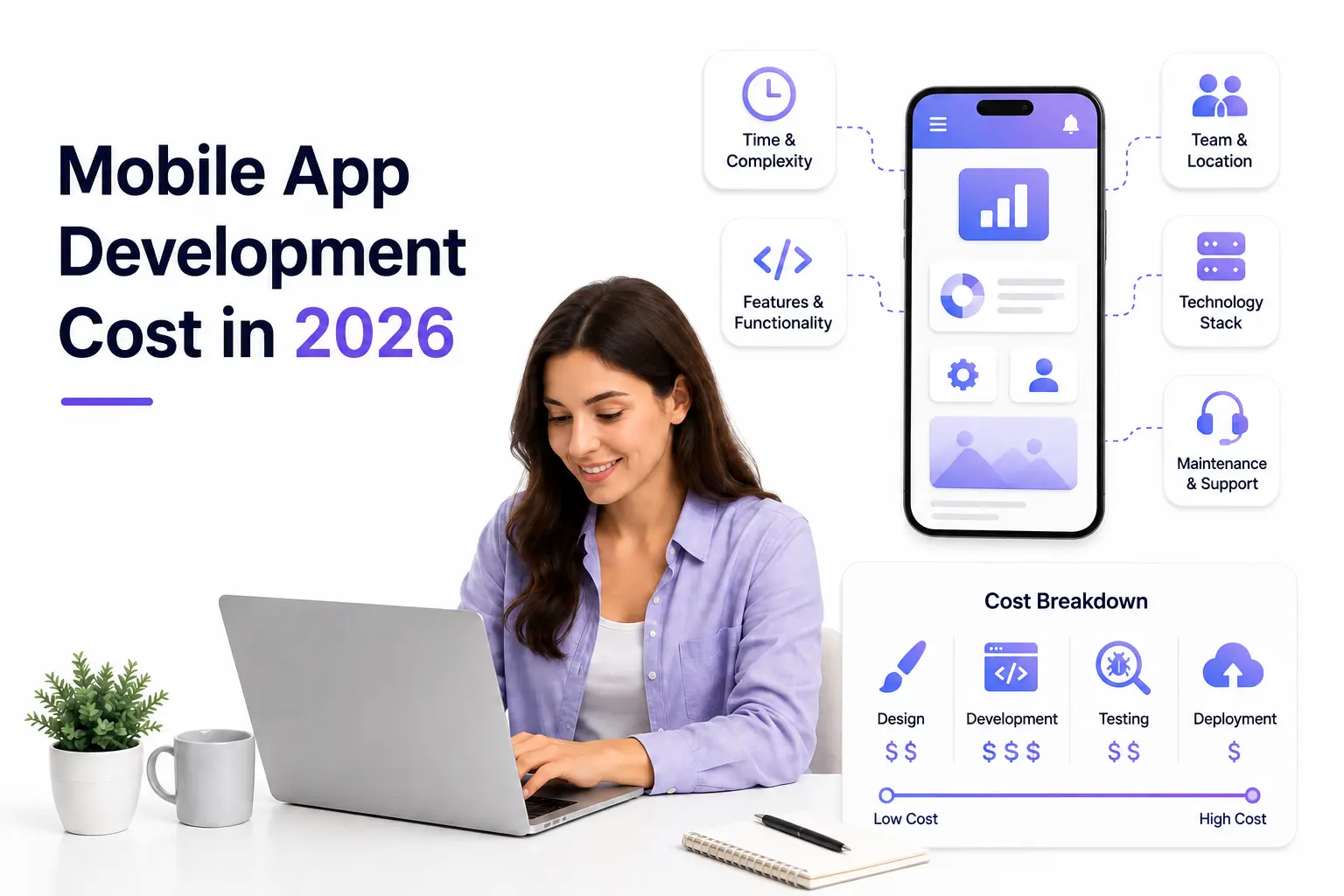
Mobile App Development Cost in 2026: Complete Guide
Understand Mobile App Development Costs, Key Pricing Factors, Timelines, Platforms, and Ways to Plan Your App Budget in 2026.Mobile App Development Cost in 2026: Complete Guide
Gaurang Mistry
21 August 2026
Building a mobile app is a significant business decision, and understanding the mobile app development cost before development begins can help you plan your investment more effectively. There is no universal price for building an app because every project has different requirements, features, platforms, integrations, design needs, and technical complexity.
A simple MVP with a few core features can require a very different level of investment than an enterprise application with real-time functionality, advanced security, multiple integrations, or AI-powered capabilities. In this guide, we will explain the major factors that influence mobile app development cost in 2026, how complexity and platform affect the budget, what ongoing expenses to consider, and how businesses can reduce unnecessary development costs without compromising the quality of the product.

How Much Does Mobile App Development Cost in 2026?
The cost of developing a mobile application depends primarily on the scope of the project. A basic application with limited screens, straightforward functionality, and minimal backend requirements generally requires less development effort than a complex platform with multiple user roles, real-time features, payments, third-party integrations, and advanced security.
Instead of looking at one fixed price, businesses should think about mobile app development cost in terms of investment levels. The following framework can help you understand how development requirements typically affect the overall budget.
App Complexity | Investment Level | Typical Development Timeline |
|---|---|---|
Basic / MVP | Lower investment | Shorter development cycle |
Medium Complexity | Moderate investment | Medium development cycle |
Complex Application | High investment | Longer development cycle |
Enterprise Application | Custom investment | Long-term development cycle |
These categories are intended for planning rather than as fixed pricing. Current industry research shows that app development costs can vary widely depending on features, UX complexity, backend requirements, technology choices, and project scope. Clutch's 2026 research, for example, identifies features, UX complexity, and backend development as major factors affecting development costs.
The most useful question is therefore not simply "How much does an app cost?" but rather "What does my app need to accomplish, and how much development effort will that require?"
Mobile App Development Cost by App Complexity
Basic and MVP Mobile Apps
A basic or MVP application focuses on the essential functionality required to launch and validate a product idea. It may include a limited number of screens, straightforward navigation, user registration, basic profiles, content management, simple notifications, and a relatively lightweight backend.
This type of application is often suitable for startups testing a new concept or businesses that want to launch a focused digital product without building every planned feature at once. An MVP approach can help reduce the initial development scope and provide an opportunity to collect real user feedback before investing in more advanced functionality.
Medium-Complexity Mobile Apps
Medium-complexity applications require more sophisticated functionality and usually involve a larger development effort. Examples can include booking platforms, e-commerce applications, business apps, educational platforms, community applications, and service-based mobile products.
These applications may require authentication, databases, APIs, payment integrations, push notifications, admin panels, multiple user roles, analytics, and customized UI/UX. Each additional workflow needs to be designed, developed, tested, and maintained, which naturally increases the overall development investment.
Complex Mobile Apps
Complex mobile applications usually involve advanced business logic, multiple integrations, real-time functionality, sophisticated backend systems, or demanding security requirements. Examples include fintech platforms, healthcare applications, logistics systems, on-demand services, enterprise platforms, and applications with advanced AI capabilities.
These projects often require collaboration between mobile developers, backend engineers, UI/UX designers, QA specialists, and other technical professionals. Cloud infrastructure, security, scalability, real-time communication, advanced analytics, and external services can further increase the development effort and long-term maintenance requirements.
Enterprise Mobile Apps
Enterprise applications typically have broader requirements than consumer-focused apps. They may need to connect with existing CRM, ERP, HR, payment, analytics, authentication, or other internal systems while supporting multiple departments, user roles, and permission levels.
Security, scalability, compliance, monitoring, documentation, and long-term support are also important considerations. Enterprise projects are therefore usually planned as long-term technology products rather than one-time development projects, with development taking place across multiple phases and releases.
What Factors Affect Mobile App Development Cost?
Features and Functionality
Features are one of the biggest factors affecting mobile app development cost. A basic login system is relatively straightforward, while functionality such as real-time chat, video calling, location tracking, advanced search, subscriptions, payment processing, recommendation engines, or AI-powered features can require considerably more development work.
Every feature also needs to be considered across design, development, testing, security, and maintenance. For this reason, businesses should prioritize features based on their actual business value rather than attempting to include every possible capability in the first release.

UI/UX Design
A professional mobile application needs more than visually attractive screens. The design process may include user research, information architecture, wireframing, prototyping, usability testing, visual design, and design-system creation.
The complexity of the user experience can influence development effort as well. Applications with multiple user journeys, personalized dashboards, complex forms, animations, or customized interactions typically require more design and development work than straightforward applications.
Good UI/UX planning can also help control development costs because problems can be identified at the design stage instead of after development has already started.
Platform Selection
Choosing between native and cross-platform development can affect the overall development effort. A business targeting only one platform may choose native development, while a company planning to launch on both iOS and Android may consider a cross-platform approach.
However, platform selection should not be based on cost alone. Performance requirements, device capabilities, integrations, user expectations, maintenance requirements, and the long-term product roadmap should all be considered before choosing the technology.
Backend Development
The mobile application is only the visible part of many modern products. Behind the app, there may be databases, APIs, authentication systems, business logic, cloud infrastructure, admin dashboards, notifications, analytics, and other backend services.
A simple app may need only a lightweight backend, while a marketplace, fintech platform, enterprise application, or SaaS product may require a much more sophisticated architecture. Backend complexity can therefore have a significant impact on the total mobile app development cost.
Third-Party Integrations
Many applications depend on external services to provide specific functionality. Common examples include payment gateways, maps, social login, cloud storage, analytics platforms, CRM systems, communication tools, and AI services.
Each integration requires implementation, testing, error handling, security considerations, and ongoing compatibility management. Some third-party services may also have their own subscription, transaction, or usage-based charges, which should be included in the broader product budget.
Security and Compliance
Security becomes particularly important when an application handles financial transactions, personal information, healthcare data, business information, or other sensitive content.
Secure authentication, encryption, access controls, API security, audit logging, vulnerability testing, and compliance requirements can all add to the development effort. Security should ideally be considered from the architecture and planning stage rather than treated as an afterthought.
Mobile App Development Cost by Platform
Businesses generally choose between native development and cross-platform development based on their product requirements. Native iOS and Android development can be appropriate when an application needs deep platform-specific functionality, specialized performance, or extensive access to native device capabilities.
Cross-platform technologies such as Flutter and React Native can allow businesses to build applications for multiple platforms while sharing a significant portion of the codebase. This can help reduce duplicated development work in suitable projects, although the final effort still depends on the application's features, integrations, and native requirements. If you're comparing these two cross-platform approaches in more detail, read our guide to Flutter vs React Native to understand their differences in performance, development speed, ecosystem, and use cases.
Development Approach | Best Suited For | Cost Consideration |
|---|---|---|
Native iOS | Apple-focused applications | Platform-specific development |
Native Android | Android-focused applications | Platform-specific development |
Flutter | Cross-platform products | Shared codebase for multiple platforms |
React Native | Cross-platform applications | Shared development with native integration options |
Saturncube currently provides mobile application development using Flutter, React Native, Swift, and Kotlin, allowing the technology approach to be selected according to the product's requirements rather than forcing every project into the same framework.
Mobile App Development Cost by App Type
The type of application can influence development effort because different products require different workflows and technical capabilities. An e-commerce application may need product catalogs, search, shopping carts, payment processing, order management, shipping integrations, notifications, and customer accounts.
A healthcare application may require appointment scheduling, secure communication, patient information management, and additional security controls. Similarly, fintech applications can involve financial integrations and stronger security requirements, while on-demand applications may require location tracking, real-time status updates, payments, and multiple user roles.
AI-powered applications can introduce another layer of complexity. Depending on the use case, they may require AI APIs, data processing, model integration, retrieval systems, analytics, and additional infrastructure. The important point is that app category alone does not determine mobile app development cost. The actual features and technical requirements matter more.

Hidden Costs of Mobile App Development
The initial development budget is not the only expense businesses should consider. After an application is launched, it may require hosting, cloud infrastructure, monitoring, bug fixing, security updates, operating system compatibility updates, third-party service subscriptions, and ongoing technical support.
There can also be costs related to analytics, customer support, payment processing, app store requirements, infrastructure scaling, and future feature development. These expenses may change as the application grows, so businesses should consider them when creating a long-term product budget rather than focusing only on the initial development phase.
Post-launch development is also important because applications rarely remain unchanged. User feedback, new devices, operating system updates, changing business requirements, and new market opportunities can all create the need for additional releases and improvements.
How Long Does It Take to Build a Mobile App?
Development time depends on the application's scope, complexity, technology, number of platforms, integrations, team structure, and feedback cycles. A basic MVP may have a shorter development cycle, while complex applications with extensive backend systems, security requirements, and integrations can require significantly more time.
A useful planning framework is:
These are planning categories rather than guaranteed delivery timelines. Discovery, UI/UX design, development, testing, client feedback, third-party integrations, deployment, and technical changes can all influence the final schedule.
Current 2026 industry research also emphasizes that project scope and complexity have a major influence on both cost and timeline. GoodFirms' latest research, for example, reports a broad 3–18+ month development range depending on complexity, features, platform compatibility, and scalability requirements.
How to Reduce Mobile App Development Costs
Reducing development cost does not necessarily mean choosing the cheapest development team. A better approach is to reduce unnecessary development work while keeping the core product quality intact.
Start With an MVP
An MVP allows businesses to focus on the core functionality needed to validate an idea. Features that are useful but not essential can be moved into future releases based on user feedback and business priorities.
Prioritize Features
Create a clear distinction between must-have, should-have, and future features. This helps development teams focus resources on functionality that directly contributes to the product's initial goals.
Choose the Right Technology
Selecting the appropriate platform and framework can prevent unnecessary development effort. For example, a cross-platform approach may be suitable for a business that wants to launch on both iOS and Android with a shared codebase.
Plan UI/UX Before Development
Well-defined user flows, wireframes, and prototypes can reduce misunderstandings during development. Finding a usability issue in a prototype is generally easier than discovering the same problem after multiple screens have already been developed.
Plan for Future Scalability
A low-cost solution that requires a complete rebuild as the user base grows may become more expensive in the long term. The architecture should therefore be appropriate for the expected product roadmap and business growth.
How to Choose the Right Mobile App Development Approach
The right development approach depends on the product rather than a single universal technology recommendation. Native development can be suitable when platform-specific performance or device capabilities are critical. Cross-platform development may be appropriate when a business wants to launch on multiple platforms while maintaining a shared codebase.
For custom business applications, businesses should also consider backend architecture, UI/UX requirements, security, third-party integrations, scalability, maintenance, and future development needs. The goal should be to select a technology approach that balances development efficiency with the application's long-term requirements.
Saturncube provides mobile app development services for startups and enterprises, covering product strategy, UI/UX design, custom development, testing, deployment, and post-launch support. Its current mobile offering includes Flutter, React Native, iOS, Android, API integrations, MVP development, and custom application development.

When Should You Hire a Mobile App Development Company?
Working with a professional mobile app development company can be useful when your application requires custom functionality, multiple platforms, backend development, third-party integrations, advanced security, or ongoing technical support.
A development partner can help with more than writing code. The process can include requirement analysis, product planning, UI/UX design, technology selection, architecture, development, quality assurance, deployment, and post-launch improvements. Having these activities coordinated by one team can make the development process easier to manage.
This approach can be particularly useful for startups and enterprises that want to build a product for long-term growth. Instead of treating the application as a one-time project, the development team can continue supporting new features, performance optimization, operating-system updates, security improvements, and future versions.
Frequently Asked Questions
How much does it cost to develop a mobile app in 2026?
There is no single cost that applies to every mobile application. The mobile app development cost depends on the app's features, complexity, platform, UI/UX requirements, backend architecture, integrations, security requirements, and development timeline. Basic applications generally require a lower investment, while complex and enterprise products require a higher or customized investment.
What is the average cost of developing a mobile app?
A single average can be misleading because mobile applications vary significantly in scope. Current industry research shows a wide range of project costs, with Clutch reporting that most reviewed app development projects fall between $10,000 and $49,999 while its dataset also shows a much higher average when considering larger projects. For this reason, businesses should estimate cost based on their actual requirements rather than relying on one average figure.
How much does it cost to build a simple mobile app?
A simple mobile app generally requires a lower investment than a medium or complex application because it typically has fewer screens, workflows, integrations, and backend requirements. The actual cost depends on the platform, features, design, development approach, testing requirements, and any third-party services involved.
Is Flutter cheaper than native app development?
Flutter can reduce duplicated development work when a business wants to build for both iOS and Android because it allows teams to share much of the application code. However, the final development effort depends on the app's features, integrations, native functionality, testing, and maintenance requirements. The right choice should therefore be based on the product's technical needs rather than price alone.
How long does it take to develop a mobile app?
A basic application can have a relatively short development cycle, while medium, complex, and enterprise applications require progressively more time. Features, UI/UX complexity, backend development, integrations, testing, team size, and feedback cycles all influence the final timeline.
What makes mobile app development more expensive?
Advanced functionality, complex user experiences, real-time features, custom backend systems, payment processing, location services, multiple integrations, advanced security, multiple platforms, and extensive testing can all increase development effort. A larger scope generally means more development and QA work, which increases the overall investment.
Can I reduce mobile app development costs by building an MVP?
Yes. An MVP focuses on the core features required to validate a product idea. Instead of building every planned feature at launch, businesses can release a focused version, collect user feedback, measure adoption, and then prioritize future development based on actual user needs.
Final Thoughts on Mobile App Development Cost in 2026
Understanding mobile app development cost is less about finding one fixed number and more about understanding what goes into building the product. Features, complexity, platform, UI/UX design, backend architecture, integrations, security, testing, and ongoing maintenance can all influence the final investment.
A well-planned MVP, clear feature priorities, appropriate technology selection, and scalable architecture can help businesses manage development resources more effectively. Instead of focusing only on the lowest initial cost, consider the application's long-term requirements, maintenance needs, user experience, and ability to scale.
If you are planning a new mobile application, Saturncube can help you evaluate your requirements, choose an appropriate development approach, and take the product from planning and UI/UX design through development, testing, deployment, and ongoing support. Explore Saturncube's mobile app development services to discuss your project requirements.