


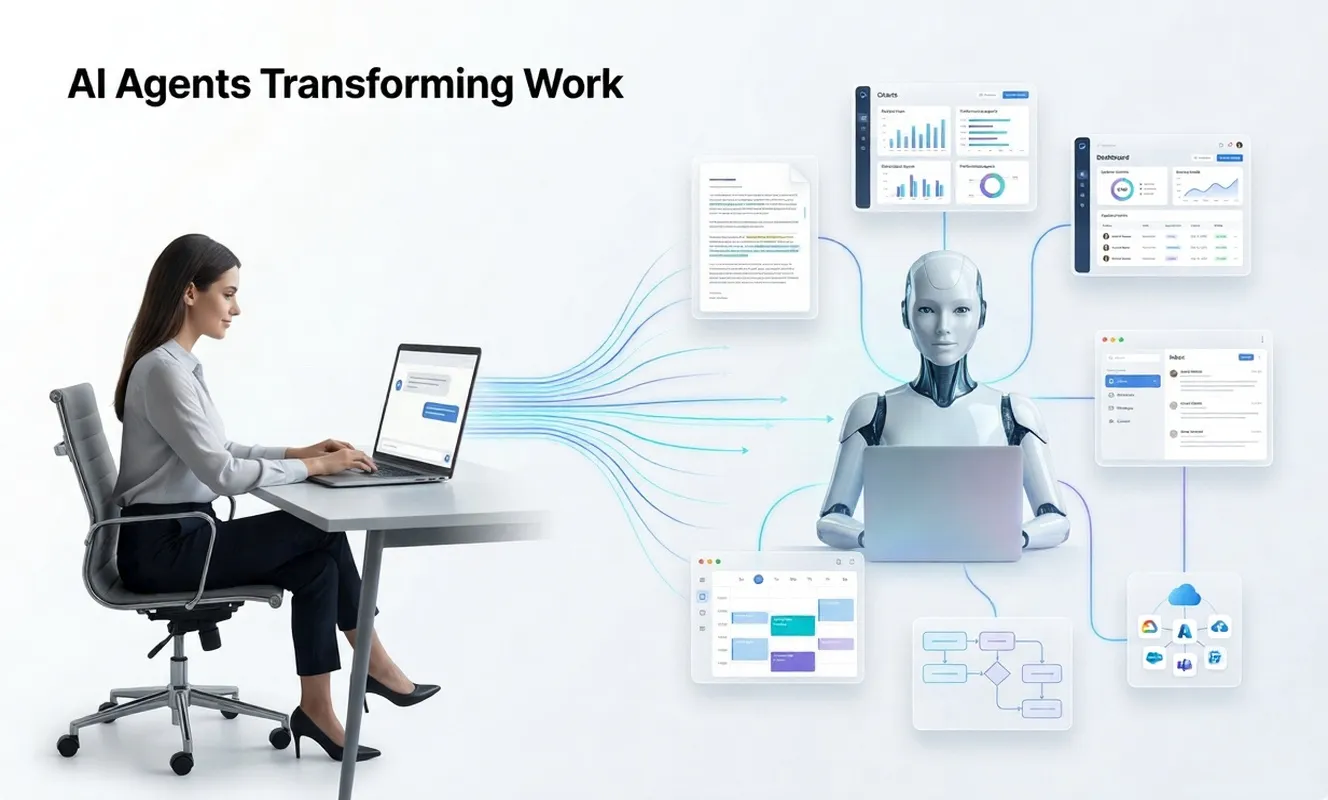
AI Agents Are Quietly Replacing Chatbots at Work
New research shows employees across every department are shifting from chatbots to AI agents for hours-long, autonomous work. Here is what the data shows and what it means for businesses.
Gaurang Mistry
30 June 2026
For the past few years, the default way most people interacted with AI was a single back-and-forth conversation. Ask a question, get an answer, ask a follow-up. That pattern is changing fast, and recent internal data from one of the largest AI companies in the world shows exactly how fast.
A new economic research study tracking internal AI usage found something that should change how every business thinks about AI adoption. Employees are not just chatting with AI anymore. They are handing it entire tasks and walking away for hours while it works independently.
This shift isn't theoretical - it's happening now. Our AI Software Development team is helping companies make this transition every day.

The Shift From Conversations to Delegated Work
The fundamental difference between a chatbot and an AI agent comes down to how long the AI can work without you. A chatbot interaction is short and self-contained. You ask, it answers, the interaction ends. An agent is different. It can run independently for minutes or hours, making decisions, calling tools, checking its own work, and adjusting its approach until the task is actually done.
This distinction is not theoretical. The data below shows how quickly users moved from short prompts to long, delegated tasks over a six-month period.
Task Length (estimated human time) | Share of Users Who Made That Request |
|---|---|
More than 30 minutes | 80.6% |
More than 1 hour | 70.2% |
More than 4 hours | Growing fastest, from a low base |
More than 8 hours | 25.6% |
A quarter of users handed off work that would have taken a person more than a full workday to complete. That is not a chatbot use case. That is delegation.
What Happened Inside the Company That Built the Tool
The most telling part of this research is not what outside companies are doing. It is what happened inside the company building the tool itself.
Through August 2025, the average employee spent less than 10% of their AI usage on the agentic coding tool. Most work still went through the standard chatbot interface. Within months, that completely flipped. Every department, including non-technical teams like Legal and Recruiting, made the agentic tool their primary way of using AI at work.
By the most recent data, the average employee generates more than 85% of their AI output through the agent rather than the chatbot. For engineers specifically, that number reached 99%. The agent tool now accounts for nearly all weekly AI usage company-wide, because people using agents generate far more total output than people sticking to chat-based interactions.
The Surprising Part: Non-Technical Teams Adopted Faster Than Engineers
Engineers were the first to adopt agentic AI tools, which makes sense since the tool was originally built for coding. But the growth data tells a different story about where the momentum actually is.
Non-developer usage grew dramatically faster than developer usage across every group measured:
This matters because it shows agentic AI is not staying confined to engineering teams. Legal teams, recruiters, finance staff, and operations people are now routinely using AI agents to handle work that used to require either specialized technical skill or hours of manual effort.
One particularly interesting finding: workers in non-technical business functions used the agent for coding or technical execution in over a quarter of their tasks. People without a technical background are now using AI agents to automate processes, transform data, debug issues, and run structured analysis, work that previously would have required pulling in a developer.
Why This Matters for Every Business, Not Just Tech Companies
The pattern described in this research is not unique to one company. It reflects a broader shift happening across how businesses are starting to use AI in 2026.
The businesses that get the most value from AI right now are not the ones treating it as a smarter search engine. They are the ones building workflows where AI agents handle entire chunks of work independently, with a person reviewing the output rather than guiding every single step.
This is exactly the shift we have been seeing in client conversations at Saturncube. Businesses that started with simple chatbot integrations are now asking us to build AI agent development that can handle complete workflows: qualifying a lead from start to finish, processing a batch of documents, reconciling data across systems, or running a multi-step research task without a human checking in at every stage.
The economic case is straightforward. If an agent can reliably handle work that would take a person several hours, and a team member only needs to review the output rather than do the work itself, the time savings compound quickly across a business. The research found this pattern accelerating, not plateauing, as the underlying AI models and the agentic systems built on top of them keep improving.
What This Means for How Businesses Should Be Thinking About AI
A few practical takeaways come out of this data that apply well beyond the company that produced the research.
Chatbot-only AI strategies are likely to become outdated quickly. If the trend holds, businesses still relying purely on chat-based AI tools a year from now will be doing meaningfully less with AI than competitors who have moved to agent-based workflows.
Non-technical teams should not be an afterthought in AI adoption plans. The fastest growth in this research came from exactly the departments many businesses assume are not ready for AI agents: legal, recruiting, finance, and operations. These are often the teams handling the most repetitive, process-heavy work that agents are best suited to take over.
The gap between what AI can do and what most businesses are currently using it for is large and growing. Most companies are still in the chatbot phase. The data here suggests the businesses moving to agentic workflows now are positioning themselves well ahead of where the rest of the market will be in a year or two.
Building This Into Your Business
Moving from chatbot usage to genuine agentic workflows is not something that happens by switching tools. It requires AI software development that understands your specific business processes, connects to your existing systems, and is built with the right guardrails so an agent working independently for hours does not create problems while no one is watching.
At Saturncube Technologies, we have been building AI-powered software since 2014. Our team designs and builds AI agents for businesses across industries that need exactly this kind of long-horizon, autonomous capability, not just a chatbot bolted onto an existing product.
If your business is still primarily using AI in short, prompt-by-prompt interactions and you want to understand what a genuine agentic workflow would look like for your specific operations, talk to our team. We can walk you through what is realistic to build and where it would have the most impact.
Related Articles:
Agentic AI vs AI Agents: What Is the Difference
AI Agents and Business Automation: The Smarter Way to Run Your Business in 2026
What Is Agentic RAG and Why It Matters