


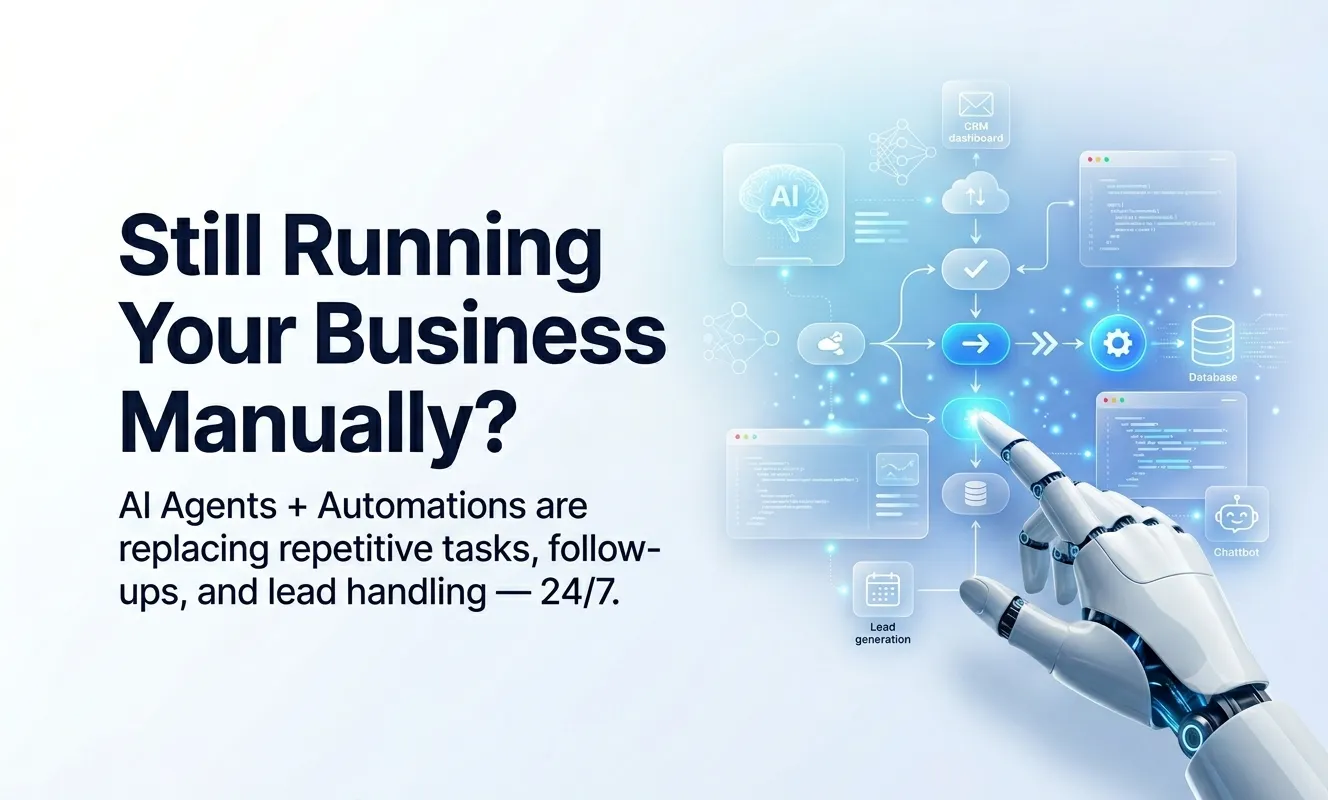
Still Running Your Business Manually?
AI Agents and Business Automation: The Smarter Way to Run Your Business in 2026
Gaurang Mistry
23 June 2026
Think about the last time a lead came in after office hours. Did someone follow up within 60 seconds? Did the CRM update automatically? Did the prospect receive a personalized message before they moved on to the next Google search result?
For most businesses, the honest answer is no. Not because the team is not trying, but because humans cannot be available 24 hours a day to handle every incoming interaction the moment it happens.
AI agents and business automation solve this. They handle the repetitive, time-sensitive parts of running a business automatically, so your team can focus on work that actually needs a human. Automate your workflows with AI agents Or hire dedicated developers to build custom automation tools

What Business Automation Actually Means
Business automation is simpler than it sounds. It just means setting up a system that takes care of a task on its own, every time a specific thing happens, without anyone manually doing it.
For example, a new lead fills out a form on your website. Instead of waiting for someone to notice it and send an email, the automation kicks in immediately. The lead gets a message, your CRM updates, and your sales team gets a notification, all within seconds.
Here are the tasks businesses most commonly automate today:
Each of these used to eat up time from real people every single day. Now they run on their own, in the background, every hour of every day.
Our main service: Web Development
What AI Agents Do That Basic Automation Cannot
Standard automation follows fixed rules. If this happens, do that. It works well for simple, predictable tasks. But business conversations are rarely simple or predictable.
A customer message does not always fit a pre-written template. A lead does not always respond the way you expected. A prospect sometimes needs a real answer to a real question before they will book a call.
This is where AI agent development becomes something entirely different. An AI agent does not just follow a script. It reads what someone wrote, understands what they actually need, and responds accordingly.
A well-built AI agent for business can:
The simplest way to understand the difference: automation sends the same message to everyone. An AI agent holds an actual conversation.
The Numbers That Show Why Speed Matters
Most business owners have heard that responding fast to leads matters. The data behind it is more serious than most people realise.
Response Time to a Lead | Likelihood of Qualifying That Lead |
|---|---|
Under 1 minute | 391% higher than 1-hour response |
Under 5 minutes | 21x more likely vs. 30-minute response |
30 minutes | Drops significantly |
Over 1 hour | Prospect has often already moved on |
Over 24 hours | Lead is effectively cold in most industries |
Source: Harvard Business Review / InsideSales Research
The math is straightforward. If you are spending money on ads, SEO, or any form of marketing to bring people to your website, and those people are not getting a response within minutes, a portion of that spend is wasted before your team even knows the lead exists.
Business automation and AI do not just save time. They protect the money you are already spending to attract customers in the first place.
Which Parts of Your Business Benefit Most
Not every business process needs to be automated. The ones that benefit most are the ones that are repetitive, time-sensitive, and happen often.
Sales is the clearest area. Following up with leads, qualifying prospects, scheduling meetings and keeping the CRM updated are tasks that happen dozens of times a month and currently take real hours away from salespeople who should be closing deals, not doing admin.
Customer support is the second big area. A large portion of the questions a support team gets are variations of the same few things. An AI agent that can handle those questions accurately frees the support team to focus on complex issues that genuinely need a human.
Marketing and internal operations round it out. Sending the right follow-up to the right segment at the right time, updating contact lists, generating reports, and routing tasks between teams are all things automation handles quietly and consistently.

Getting This Right Is Worth Doing Properly
Setting up AI-powered automation that actually works well requires more than plugging in a few tools. The configuration, the business logic behind each workflow, the testing against real scenarios, and the integration with your existing systems all matter.
A poorly built automation that sends the wrong message to the wrong person at the wrong time can damage relationships rather than build them. The tools are powerful precisely because of how much they do without any human check, which makes getting them right important.
At Saturncube Technologies, we have been building AI software and automation systems since 2014. We work with businesses across industries to design and build AI agents and automation workflows that handle real operational needs reliably, not just in demos.
If you want to understand what this looks like for your specific situation and which workflows would have the most immediate impact, get in touch with our team.
Frequently Asked Questions
What is the difference between business automation and AI agents?
Business automation follows predefined rules to complete repetitive tasks automatically, such as sending emails or updating a CRM. AI agents go a step further by understanding context, making decisions, and interacting with users through natural conversations. While automation executes workflows, AI agents can adapt their responses based on user intent.
How can AI agents help my business generate more leads?
AI agents can engage with website visitors instantly, answer questions, qualify prospects, schedule appointments, and follow up automatically. This helps businesses respond faster to leads and reduces the chances of losing potential customers due to delayed communication.
Which business processes are best suited for automation?
Processes that are repetitive, time-sensitive, and rule-based are ideal for automation. Common examples include lead management, appointment scheduling, CRM updates, email follow-ups, customer support requests, task routing, and internal reporting workflows.
Can AI agents integrate with my existing CRM and business tools?
Yes. Modern AI agents can be integrated with popular CRMs, communication platforms, calendars, helpdesk systems, and business applications. This allows information to flow automatically between systems without manual data entry.
Is AI agent development suitable for small and medium-sized businesses?
Absolutely. AI agents are not limited to large enterprises. Startups and growing businesses can use AI-powered automation to improve customer response times, streamline operations, reduce manual workload, and scale more efficiently without significantly increasing operational costs.
Stop Doing Manual Work
Whether you need AI-powered automation or a dedicated team to build custom tools, we can help.
Related Articles:
Agentic AI vs AI Agents: What Is the Difference
AI Agents for Financial Services: What Banks Are Doing in 2026
What Is Agentic RAG and Why It Matters