


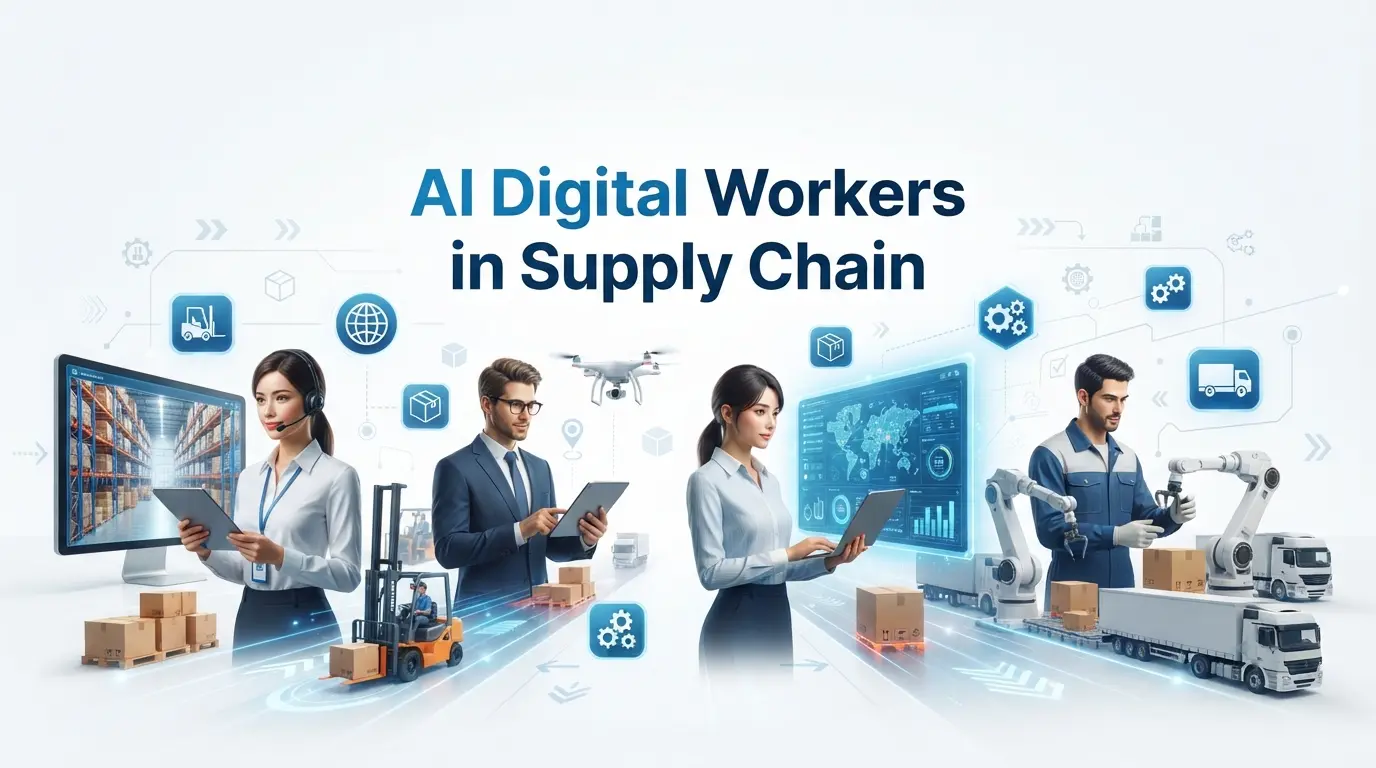
Discover how AI digital workers are transforming supply chain operations through inventory monitoring, shipment tracking, supplier coordination, warehouse management, and intelligent planning, with practical use cases and implementation strategies.
Gaurang Mistry
2026-11-27
Supply chains depend on hundreds of connected activities, including procurement, inventory management, order processing, transportation, warehousing, and supplier coordination. When these activities run across disconnected systems, teams often spend significant time gathering information, tracking delays, updating records, and responding to unexpected changes. Traditional automation can handle repetitive tasks, but it often struggles when a process requires understanding changing conditions, evaluating multiple factors, or coordinating decisions across departments.
This is where AI digital workers are becoming increasingly relevant. Unlike basic automation tools that follow predefined instructions, AI-powered digital workers can interpret information, monitor operational conditions, coordinate tasks, and take actions within approved business rules. They can support supply chain professionals by handling routine operational work and helping teams respond faster to disruptions. As businesses explore more intelligent ways to manage complex operations, digital workers are emerging as a practical approach to improving supply chain visibility, responsiveness, and efficiency.

AI digital workers are software-based systems designed to perform specific business responsibilities with varying levels of autonomy. They can understand requests, retrieve information from connected systems, analyze operational data, follow business rules, and execute approved actions. In supply chain management, a digital worker might monitor inventory levels, check shipment updates, identify a potential delivery delay, notify the relevant team, and recommend an appropriate response. Depending on its permissions and system integrations, it may also update records or initiate the next step in a workflow.
A digital worker is not simply a chatbot that answers employee questions. A chatbot primarily communicates information, while an AI digital worker can help complete operational tasks. For example, a chatbot might tell a warehouse manager that an order is delayed. A digital worker could investigate the order status, retrieve carrier information, check the expected delivery date, identify the affected orders, and prepare an escalation for the operations team. The distinction is its ability to connect information with actions rather than only generate responses.
Digital workers can use a combination of artificial intelligence, large language models, APIs, workflow automation, business rules, and enterprise data integrations. Some operate independently within clearly defined boundaries, while others work alongside employees who approve important decisions. This flexibility makes AI agent development relevant to businesses that want to build digital workers around their specific supply chain processes instead of relying entirely on generic automation tools.
Supply chain operations are becoming more interconnected, but many organizations still manage critical activities through separate software platforms, spreadsheets, emails, and manual coordination. A delay in procurement can affect production schedules, inventory availability, warehouse planning, and customer delivery commitments. Employees may need to check multiple systems before understanding what happened and deciding what to do next. This creates operational friction, particularly when teams handle large order volumes or work with multiple suppliers and logistics partners.
AI adoption is also moving beyond experimentation toward practical operational applications. McKinsey's September 2026 State of Digital Logistics research, based on a survey of 278 shippers, found that nearly 90% had adopted at least one surveyed transportation AI use case, while 96% had deployed at least one surveyed AI and digital use case in warehousing. These figures describe adoption of AI and digital capabilities broadly, not digital workers alone. However, they illustrate why intelligent systems are receiving greater attention across logistics and warehouse operations.
Gartner also forecast in April 2026 that spending on supply chain management software with agentic AI capabilities could grow from less than $2 billion in 2025 to $53 billion by 2030. This is a market forecast rather than a guarantee of business results. It reflects growing interest in AI systems that can move beyond providing recommendations and participate in completing operational workflows.
For businesses, the opportunity is not simply to automate more tasks. It is to reduce the time between identifying an operational issue and taking an appropriate action. Digital workers can help connect information, decisions, and execution across different parts of the supply chain.
AI digital workers can support different supply chain functions depending on the organization's operational requirements, available data, existing software, and automation maturity. A business does not need to deploy an autonomous system across every department at once. It can begin with a clearly defined workflow where repetitive coordination or delayed responses create measurable problems.
The following use cases demonstrate how digital workers can contribute to everyday supply chain operations.
Inventory management requires businesses to balance product availability against storage costs and the risk of excess stock. A digital worker can continuously monitor inventory records, sales activity, incoming purchase orders, and predefined stock thresholds. When inventory falls below an approved level, it can notify the responsible team, retrieve supplier information, and prepare a replenishment recommendation based on demand and purchasing rules.
More advanced systems can evaluate multiple signals before recommending an action. For example, an AI digital worker may consider seasonal demand, supplier lead times, historical sales, current warehouse capacity, and pending deliveries. It can highlight products that may face shortages and explain the factors behind its recommendation. Purchase orders or changes to stock policies should remain subject to the approval rules established by the business.
Transportation teams often need to monitor shipments across multiple carriers, locations, and delivery schedules. A shipment tracking digital worker can collect status updates from connected logistics platforms, carrier APIs, GPS systems, and order management software. It can identify shipments that have stopped moving, deviated from expected routes, or may miss their estimated delivery dates.
When a potential disruption is detected, the digital worker can retrieve the relevant order details, identify affected customers or locations, and notify the appropriate operations team. It can also prepare alternative delivery options for review when route changes or carrier substitutions are necessary. McKinsey's September 2026 logistics research describes agentic track-and-trace applications that monitor route deviations, temperature excursions, late deliveries, and potential theft events, helping organizations intervene before problems become more serious.
Procurement teams regularly handle supplier inquiries, purchase order confirmations, delivery updates, quotation requests, and documentation. Much of this work involves repeated communication and checking information across different systems. An AI digital worker can retrieve purchase order details, prepare supplier follow-up messages, monitor expected delivery dates, and organize responses for the procurement team.
For example, if a supplier has not confirmed a purchase order within the expected period, the digital worker can identify the outstanding request and prepare a follow-up. When a supplier shares a revised delivery date, the system can compare it with the required delivery schedule and highlight possible production or inventory risks. More advanced workflows may also support supplier comparisons and procurement recommendations, while supplier selection and financial commitments remain subject to authorized approval.
Warehouse operations involve receiving goods, updating stock records, assigning storage locations, picking products, packing orders, and coordinating dispatch. A digital worker can support these activities by retrieving order information, monitoring task status, identifying incomplete steps, and notifying the relevant employees when an exception occurs.
For instance, when an order is ready for dispatch but a required item is unavailable, a digital worker can check inventory across connected locations and prepare possible fulfillment alternatives. It may also identify orders approaching their dispatch deadlines and prioritize notifications according to business rules. AI agents can assist with warehouse coordination, but physical activities such as picking, sorting, and moving goods require suitable warehouse systems, robotics, or human operators. Software-based digital workers and physical AI systems should not be treated as the same technology.
Demand changes can affect purchasing decisions, production schedules, inventory levels, and transportation requirements. Digital workers can collect historical sales information, current orders, inventory data, seasonal patterns, and other relevant signals to support demand planning. They can highlight unusual changes, identify potential stock shortages, and prepare scenarios for supply chain planners.
For example, if demand for a product increases unexpectedly, a digital worker can compare current stock with incoming deliveries and supplier lead times. It can then prepare a recommendation for replenishment or inventory redistribution. Forecasting models provide the underlying predictions, while AI agents can help interpret those predictions, coordinate follow-up activities, and present the information in a way that supports operational decisions.
Unexpected events are among the most challenging parts of supply chain management. Supplier delays, incorrect order information, transportation disruptions, inventory discrepancies, and sudden changes in demand can affect multiple departments. Employees often need to investigate each issue manually, determine its impact, and coordinate with other teams before taking action.
A digital worker can monitor operational events and flag exceptions based on predefined thresholds. It can gather relevant information, identify affected orders, prepare a summary of the issue, and recommend possible next steps. For example, when a delayed shipment affects several customer orders, the system can identify those orders and prepare an escalation for the logistics manager. High-impact decisions, such as approving additional costs or changing critical delivery commitments, should remain under human control.
The value of digital workers depends on how well they solve real operational problems. Simply introducing an AI tool does not automatically improve business performance. Organizations need to connect digital workers to useful data, clearly defined workflows, and measurable business objectives. When implemented appropriately, they can help reduce manual coordination and improve the consistency of everyday operations.
Some of the main benefits include:
These benefits should be evaluated through operational measurements rather than assumptions. A business may track order processing time, shipment exception resolution time, inventory accuracy, supplier response time, manual follow-up volume, and on-time delivery performance. Comparing these indicators before and after implementation helps determine whether digital workers are delivering meaningful improvements.

Traditional automation and AI digital workers can complement each other, but they solve different types of problems. Rule-based automation is effective when a task follows a predictable sequence with clearly defined inputs and outputs. For example, automatically sending an order confirmation after a successful payment is a suitable rule-based workflow. It does not require a system to interpret complex information or decide what to do when unexpected conditions arise.
AI digital workers are more useful when a workflow involves changing information, unstructured documents, multiple connected systems, or decisions that depend on context. They can interpret supplier messages, summarize shipment issues, retrieve relevant records, and recommend actions based on the information available. However, their outputs can be incorrect or incomplete, so important actions need appropriate validation and permissions.
A practical supply chain solution often combines both approaches. Traditional automation can execute predictable steps, AI models can interpret information, and digital workers can coordinate tasks across systems. Human employees provide judgment and approval wherever the business requires additional control.
Implementing digital workers successfully requires more than selecting an AI model or automation platform. Businesses must understand their existing workflows, identify suitable tasks, prepare reliable data, and define how the system will interact with employees and enterprise software. A phased approach helps reduce implementation risk and makes it easier to evaluate results before expanding to more complex operations.
Start by identifying activities that consume significant employee time or frequently experience delays. Examples may include supplier follow-ups, shipment monitoring, order status inquiries, inventory alerts, or exception reporting. Evaluate how often the task occurs, how much manual effort it requires, what information it depends on, and what happens when it is not completed on time.
Avoid beginning with a broad objective such as automating the entire supply chain. Instead, choose one specific workflow with a clear business problem and measurable outcome. A well-defined starting point makes it easier to determine whether an AI digital worker is appropriate or whether a simpler automation workflow would be sufficient.
Before development begins, identify where the information required by the digital worker currently resides. Supply chain data may be distributed across ERP platforms, warehouse management systems, transportation management systems, inventory databases, CRM software, spreadsheets, and external supplier or carrier platforms.
The development team should examine available APIs, data formats, access permissions, update frequency, and integration limitations. Data quality is particularly important because incorrect product identifiers, outdated inventory records, or inconsistent supplier information can lead to unreliable recommendations. Businesses should establish which systems are authoritative sources for specific information and how the digital worker should handle missing or conflicting records.
Define exactly what the digital worker is expected to do and which activities it is not allowed to perform. Its responsibilities may include monitoring shipment updates, retrieving purchase order details, preparing supplier communications, or generating exception reports. These responsibilities should be translated into clear workflows with defined triggers, expected outputs, and escalation conditions.
The business must also establish permission boundaries. Reading inventory information may be allowed automatically, while changing stock quantities or approving purchase orders may require employee authorization. Defining these limits early helps prevent unintended actions and makes the system easier to test, monitor, and maintain.
The development process may involve large language models, AI agent frameworks, APIs, databases, workflow automation tools, and enterprise software integrations. The appropriate technology depends on the complexity of the workflow, the type of information being processed, security requirements, and the organization's existing infrastructure.
For workflows involving multiple responsibilities, a coordinated architecture may be useful. For example, one agent can monitor shipments, another can retrieve order information, and a coordination layer can organize the results and prepare an escalation. Businesses considering this approach can explore multi-agent AI systems to understand how specialized agents work together. The architecture should remain as simple as possible while meeting the actual operational requirements.
Before production deployment, test the digital worker using realistic operational scenarios. Include normal situations, missing information, duplicate records, delayed updates, conflicting data, and unexpected exceptions. Verify that it retrieves the correct information, follows the approved workflow, respects access permissions, and escalates decisions that require human intervention.
Once the system is deployed, monitor its performance continuously. Track task completion rates, error frequency, escalation volume, response time, and the business outcomes associated with the workflow. Collect feedback from employees who use the system and improve its instructions, integrations, and business rules as needed. Only expand to additional workflows after the initial implementation demonstrates reliable performance.
A production-ready digital worker usually relies on several connected components rather than a single AI model. The architecture should support information retrieval, reasoning, workflow execution, system integration, and operational monitoring. The exact combination depends on whether the solution needs to process documents, communicate with external systems, coordinate multiple agents, or perform actions under strict business permissions.
Large language models can interpret natural-language instructions, summarize operational information, and help agents decide which approved tool to use. Agent frameworks provide structures for organizing tasks, managing tool calls, and coordinating workflows. APIs connect the digital worker to ERP, CRM, WMS, TMS, inventory platforms, and external services. Databases and retrieval systems provide access to the business information needed to complete each task.
Workflow automation can handle predictable steps, while monitoring and logging components record what the digital worker did and why. Access control, data validation, approval checkpoints, and audit trails are equally important. For organizations modernizing older systems, legacy software modernization can help create the integration foundation required to connect existing applications with newer AI capabilities.
The architecture should also account for failure handling. If a carrier API becomes unavailable or an inventory record cannot be verified, the digital worker should not invent missing information or proceed with an unsafe action. It should report the issue, retry only according to defined rules, or escalate it to an employee.
Although digital workers can improve operational workflows, supply chain environments introduce challenges that need to be addressed before deployment. Systems often exchange sensitive commercial information, supplier records, customer details, pricing data, and shipment information. Connecting AI tools to these systems without appropriate security controls can create unnecessary business risks.
Data accuracy is another major consideration. If the underlying ERP or inventory system contains outdated information, an AI digital worker may produce an incorrect recommendation even when its reasoning process appears reasonable. Organizations should validate data sources, establish clear ownership, and ensure that critical records can be checked before actions are executed.
Other common challenges include:
A responsible implementation should include role-based access, secure API connections, audit logs, data validation, human approval for sensitive actions, and a defined process for handling errors. Businesses should also review how their AI systems use and retain information, particularly when third-party models or services are involved.

The success of a digital worker should be measured by the operational problem it solves, not by the number of AI interactions it performs. Before implementation, establish a baseline for the selected workflow. For example, if the objective is to improve shipment exception handling, record how long employees currently take to identify, investigate, and resolve a delivery issue.
After deployment, compare the same measurements over a suitable period. Businesses can evaluate shipment exception resolution time, order processing time, inventory accuracy, supplier response time, manual follow-up volume, and the percentage of tasks completed without unnecessary escalation. It is also important to monitor incorrect actions, missed exceptions, and employee overrides rather than measuring speed alone.
A digital worker that completes more tasks but creates additional errors may not deliver meaningful value. Organizations should therefore balance productivity indicators with quality, reliability, security, and employee feedback. These measurements provide a practical basis for deciding whether to improve the existing workflow, expand the solution, or introduce additional digital workers.
The next stage of supply chain AI is likely to involve more connected systems that can coordinate activities across procurement, planning, inventory, logistics, and warehouse operations. Instead of using separate AI tools for isolated tasks, organizations are exploring specialized agents that share information and collaborate on broader workflows. A shipment monitoring agent, for example, could coordinate with an inventory agent and an order management agent when a delivery disruption affects several customer orders.
Gartner identified agentic AI and collaborative multi-agent systems among its supply chain technology trends for 2026. These developments point toward a more connected operating model in which intelligent systems can plan, recommend, and perform approved activities across different business functions. However, greater autonomy also increases the importance of transparency, accountability, security, and human oversight.
Digital workers are not a replacement for supply chain expertise. They are tools that can help employees spend less time on repetitive coordination and more time on planning, supplier relationships, risk management, and important business decisions. Organizations that focus on practical workflows, reliable integrations, and measurable outcomes will be better positioned to use these capabilities effectively.
Every supply chain has different operational requirements, software systems, approval processes, and business constraints. A digital worker designed for a logistics company may need to monitor shipments and coordinate carrier updates, while a manufacturing business may prioritize supplier communication, production planning, and inventory monitoring. This is why a custom solution should begin with an understanding of the actual workflow rather than a generic automation template.
Saturncube Technologies helps businesses explore custom software and AI solutions based on their operational needs. From AI agent development and workflow automation to enterprise integrations, the right solution can connect existing business systems and support specific supply chain responsibilities. Businesses evaluating an implementation can also review AI agent development cost to understand the factors that influence development scope, integrations, and project complexity.
If your organization is exploring digital workers for procurement, logistics, warehouse operations, or supply chain coordination, start by identifying one workflow where manual effort or delayed decisions create a measurable business problem. A focused implementation can help establish the right architecture, validate business value, and create a foundation for broader AI adoption.
Planning to build AI digital workers for your supply chain? Contact Saturncube Technologies to discuss your requirements and explore a custom AI solution.
1. What is a digital worker in supply chain management?
A digital worker is an AI-powered software system that performs defined operational responsibilities within a supply chain. It can retrieve information, monitor business events, analyze data, coordinate workflows, and execute approved actions. Examples include shipment monitoring, inventory alerts, supplier follow-ups, and order exception management.
2. How are AI digital workers different from traditional automation?
Traditional automation generally follows predefined rules and executes predictable tasks. AI digital workers can interpret information, respond to changing conditions, and coordinate multiple steps using connected systems and approved tools. Both approaches can work together, with traditional automation handling routine actions and AI supporting more context-dependent workflows.
3. Can AI digital workers integrate with ERP and warehouse management systems?
Yes. AI digital workers can connect with ERP, warehouse management, transportation management, CRM, and inventory systems through APIs and other approved integration methods. The available integration options depend on the existing software, data access, security requirements, and system capabilities.
4. Can digital workers manage supplier communication automatically?
They can support supplier communication by retrieving purchase order details, preparing follow-up messages, monitoring confirmations, and organizing supplier responses. More sensitive activities, such as approving suppliers, negotiating contractual terms, or committing payments, should follow the organization's authorization and approval processes.
5. Do AI digital workers replace supply chain employees?
AI digital workers are generally designed to support employees by handling repetitive tasks, monitoring information, and coordinating routine workflows. Human professionals remain important for strategic planni ng, complex negotiations, exception handling, relationship management, and decisions that require business judgment.
6. How long does it take to implement an AI digital worker?
The implementation timeline depends on workflow complexity, system integrations, data quality, security requirements, and the level of autonomy required. A focused solution connected to a small number of systems may be simpler to implement than a multi-agent platform coordinating several departments. A technical assessment is needed to estimate a realistic timeline.
7. How can a business start implementing AI digital workers?
A business should begin by identifying one repetitive or time-consuming supply chain workflow, mapping the systems and data involved, and defining the digital worker's responsibilities. The next steps include designing the architecture, developing integrations, testing realistic scenarios, establishing approval controls, and measuring operational performance after deployment.

Founder, Saturncube Technologies
Gaurang Mistry is the Founder of Saturncube Technologies, a software development and AI solutions company established in 2014. He leads the company's overall direction and oversees its business operations, client relationships, and project delivery.