


Custom Software Development Requirements Guide
Prepare your project brief, prioritize features, map integrations, and ask the right questions before requesting a custom software development quote.
Gaurang Mistry
09 October 2026
Planning custom software starts with understanding what your business needs to accomplish. You might want to replace spreadsheets, automate a manual workflow, build a customer portal, connect existing systems, or turn a business idea into a digital product. Whatever the goal, the first challenge is explaining your requirements clearly enough for a development team to understand the problem and recommend a suitable solution.
Preparing your custom software development requirements before requesting a quote helps you make better decisions about features, project scope, integrations, and priorities. It also gives different development companies a clearer basis for preparing their proposals, making it easier to compare what each team is actually offering. You do not need a complete technical specification before contacting a developer. You need a clear explanation of your business problem, the people who will use the software, and the outcome you want to achieve.
Why Custom Software Development Requirements Matter
A software project involves more than building screens and writing code. The development team needs to understand how your business works, which tasks the application should support, what information it will process, and how it should interact with existing tools. If these details remain unclear, the team may make assumptions that do not match your expectations, leading to additional discussions, changes in scope, or unnecessary development work.
Consider a business that wants to build an order management system. One team member may expect the software to track orders, while another may also expect inventory updates, customer notifications, invoice generation, and delivery status tracking. Without a shared understanding, both sides could agree to the project while imagining different products.
Clear requirements help prevent this disconnect. They give your development partner a starting point for evaluating technical feasibility, identifying dependencies, prioritizing features, and estimating the work involved. More importantly, they help you distinguish between what your business genuinely needs and what would simply be nice to have.

1. Start With the Business Problem, Not the Technology
Before deciding whether you need a web application, mobile app, AI solution, or enterprise platform, describe the problem you want to solve. Explain how the current process works, who is involved, where delays or errors occur, and what makes the existing approach difficult to manage. This information gives a development team a clearer picture of the underlying need instead of pushing the discussion toward a technology choice too early.
For example, saying that you need a custom dashboard does not explain what the dashboard should accomplish. A more useful requirement would describe how managers currently collect information from different spreadsheets, how long reporting takes, and which decisions they cannot make easily with the available data. That context may lead to a dashboard, an integrated reporting application, or a broader workflow improvement.
You should also explain what a successful outcome would look like. Perhaps employees need fewer manual steps, customers need better access to order information, or managers need more reliable reporting. Where possible, identify a current baseline that you can compare against after launch. You do not need to promise a particular improvement before the project begins; the objective is to define what the software is expected to improve.
2. Identify Who Will Use the Software
Different users often need different functions within the same application. An administrator might manage user accounts and system settings, employees might process daily tasks, and customers might access a portal to view orders or submit requests. Identifying these groups early helps the development team plan the right interfaces, permissions, and workflows.
For each user group, describe the main tasks they need to complete and the information they should be able to access. Consider whether users need approval permissions, restricted access to certain records, different dashboards, or the ability to export information. These requirements can influence the database design, authentication process, interface structure, and security controls.
It is also worth involving the people who will use the application regularly. Business owners may understand the overall objective, but employees who handle daily operations often know where the actual problems occur. Their input can reveal exceptions, repetitive work, and missing steps that might otherwise be overlooked during project planning.
3. Decide Which Features Belong in the First Release
One of the most important parts of custom software project planning is deciding what needs to be available at launch. When a business starts exploring a new application, ideas tend to grow quickly. Additional dashboards, reports, integrations, automation rules, and advanced features may all sound useful, but including everything in the initial scope can make the project harder to plan and manage.
Separate the essential features from improvements that can be introduced later. Essential features are those required to solve the primary business problem or make the first release usable. Secondary features can improve convenience or efficiency, while future enhancements may depend on feedback from users or changes in business needs.
For example, an initial inventory application might need product records, stock updates, user permissions, and basic reporting. Automated demand forecasting could be considered later if the business first needs to establish reliable inventory data. The development team should still understand your longer-term plans, because those plans may affect architectural decisions even when the corresponding features are not part of the first release.
A clear first-release boundary gives the team something concrete to estimate and helps you evaluate proposals without comparing different vendors' assumptions.
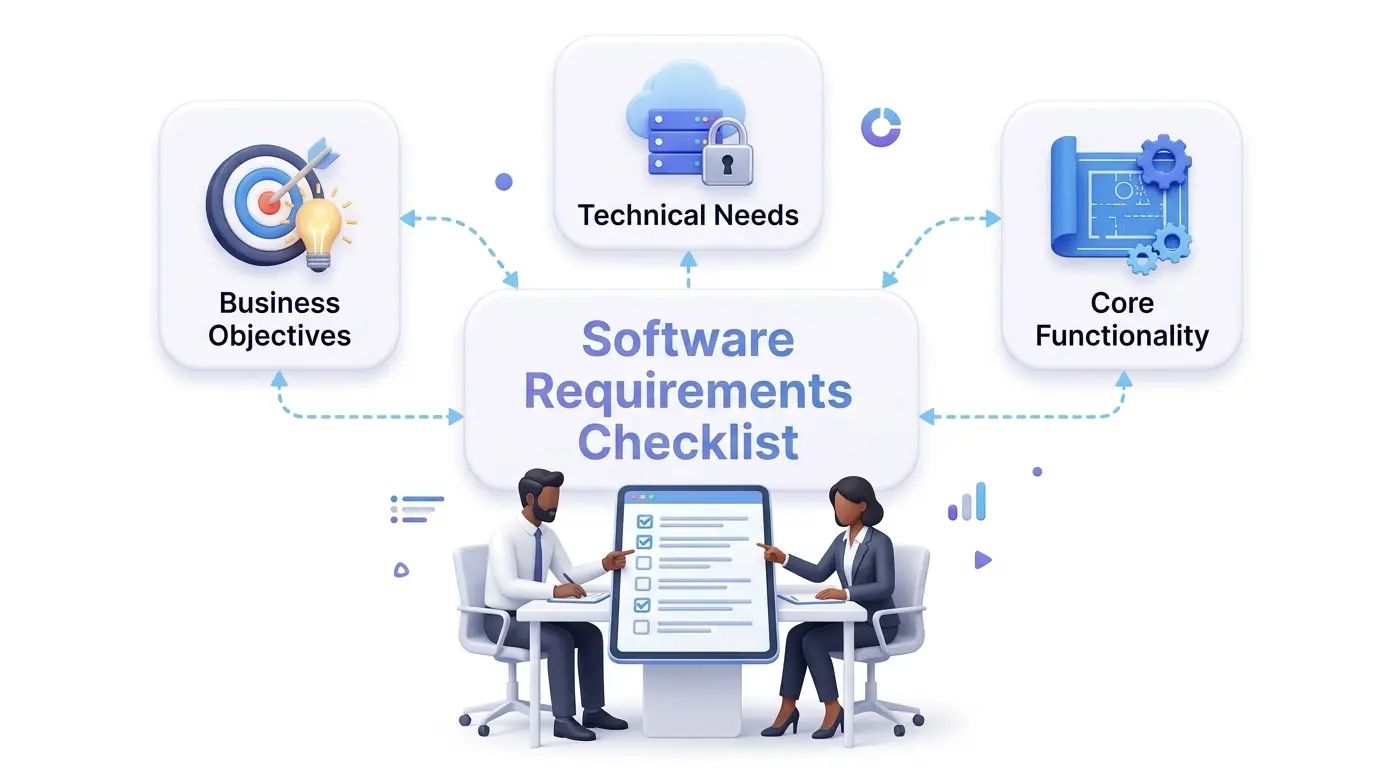
4. Prepare a Practical Software Requirements Checklist
Before contacting a development company, organize the information you already have. Your document can be short at the beginning and become more detailed as the project moves through discovery. The objective is to explain the project clearly enough for the development team to ask informed questions and identify missing decisions.
Your initial checklist should cover these areas:
You can support this document with screenshots, simple diagrams, example reports, or links to systems your team already uses. You do not need to write technical specifications for every feature yourself. Clear examples of what happens today and what should happen differently are often more useful than a long list of technical terms.
5. Document Important Workflows and Business Rules
A feature description explains what the software should do, but a workflow explains how the work actually happens. This distinction matters because business processes often involve several steps, decisions, approvals, and exceptions. If requirements describe only the ideal situation, development and testing may miss important cases.
Suppose you want to build a customer enquiry management system. You might need to record enquiries, assign them to team members, update them as conversations progress, and mark them complete when the customer receives a response. You may also need rules for duplicate enquiries, reassignment, reminders, and cases where the required information is missing. Documenting these details helps the team understand the complete process rather than just the main screen.
Where possible, show the starting point, the action performed, the expected result, and the conditions that might change the outcome. A simple flowchart or a few real examples can make complex requirements easier to discuss. Your development partner can then help turn those workflows into functional requirements, acceptance criteria, and test scenarios.

6. Identify Integrations and Existing Systems
Many custom software applications need to exchange information with tools a business already uses. These may include CRM platforms, accounting software, payment gateways, inventory systems, email services, shipping providers, or third-party APIs. Integration requirements can influence the overall architecture, development effort, testing process, and ongoing maintenance, so they should be discussed before the project scope is finalized.
Prepare a list of the systems involved and explain what information needs to move between them. For example, an ecommerce business may need order information to reach its inventory system, payment status to update the order record, and customer details to appear in a CRM. The development team will need to determine which integration methods are available, what access permissions are required, and how the system should respond if an external service is temporarily unavailable.
If your business processes involve several disconnected tools or manual data transfers, describe those problems in your project brief. SaturnCube's custom web application development services can be relevant when a business needs a web-based platform built around specific workflows, role-based access, and third-party integrations. The right technical approach should be decided after the actual requirements are understood.
7. Define Security, Data, and Performance Requirements
Security and data handling should be considered during project planning rather than left until the application is almost ready to launch. Start by identifying what information the system will store or process, who should be allowed to access it, and whether different users should have access to different records. Customer information, financial records, internal business documents, and other sensitive data may require additional controls depending on the use case.
Discuss relevant requirements for authentication, permissions, backups, data retention, audit logs, and recovery from failures. If your business operates in a regulated industry or serves customers across multiple jurisdictions, identify the applicable obligations early so they can be assessed during planning. The appropriate controls will depend on the actual data and business environment; a generic security checklist is not a substitute for a project-specific assessment.
Performance and usability also deserve clear requirements. Consider the devices people will use, expected user activity, the amount of data involved, and any operations that need to respond within a defined time. Instead of saying that the application must be fast or scalable, explain the expected workload and ask the development team to recommend measurable targets. These details help turn broad expectations into criteria that can be evaluated during testing.
8. Set Priorities, Timeline, and Budget Expectations
A useful project brief should explain when the software is needed and whether any deadlines are fixed. A product launch, an internal system replacement, or a seasonal business requirement may affect the order in which features are delivered. Explain why the deadline matters and be open to discussing which functions are essential for that date and which could be introduced in a later phase.
You should also communicate your budget expectations where possible. Even an approximate internal budget can help a development company assess different implementation approaches, identify trade-offs, and recommend a suitable project scope. If the budget has not been approved, say so rather than treating an early estimate as a final commitment.
When comparing proposals, review what each estimate includes and excludes. Consider discovery, design, development, testing, deployment, third-party services, maintenance, and post-launch support. SaturnCube's website development cost guide provides additional context on the factors that influence website project estimates. For broader software projects, the same principle applies: compare the proposed scope and assumptions, not just the final quoted amount.

9. What to Ask Before Choosing a Development Company
A development proposal should help you understand how the company plans to approach your project, not just how much it will cost. Before making a decision, ask how requirements will be validated, how project progress will be communicated, and how the team will manage changes when new information emerges. The answers can help you understand whether the proposed working process suits your business and internal team.
Use these questions during your initial discussion:
The company should also explain its assumptions and identify areas that still need investigation. A proposal may reasonably contain open questions when the project is at an early stage, but those questions should be visible rather than hidden behind an apparently precise estimate.
10. What Happens After You Share Your Requirements?
Once a development company understands your initial brief, the next step is usually to clarify the scope and investigate important unknowns. Depending on the project, this may involve stakeholder discussions, workflow mapping, technical feasibility checks, integration research, user experience planning, and prioritization of the first release.
The result should be a clearer understanding of what will be built, what remains outside the scope, which dependencies need attention, and how delivery will be organized. The amount of detail produced at this stage depends on the project and the engagement agreed with the development partner. A complex business platform may need more discovery than a small application with well-understood requirements.
This is also the right time to discuss the team's composition. Some projects need a defined delivery team, while others require ongoing access to particular technical skills. If you already have an internal team and need additional capacity, SaturnCube's dedicated developer hiring services may be relevant. If the project involves a mobile product, its mobile app development services can also be considered as part of the broader solution.
Common Mistakes to Avoid When Preparing Requirements
A common mistake is starting with a list of desired features without explaining the business problem behind them. Another is treating every idea as essential for the first release, even when some requirements have not been validated with the people who will use the software. Both approaches make it harder to identify priorities and agree on a realistic scope.
Businesses also sometimes overlook integrations, data migration, permissions, testing, and post-launch responsibilities. These areas may not be visible in an early screen mockup, but they can be important to the application working reliably in daily operations. Another mistake is comparing quotations that assume different features, timelines, or levels of support. A lower estimate may simply cover less work.
The solution is to treat requirements as a shared working document. Your business team brings knowledge of the problem and existing processes, while the development team contributes technical analysis and implementation experience. Review assumptions together, document important decisions, and agree on what the first release must accomplish before committing to a detailed delivery plan.
How SaturnCube Can Help With Your Software Project
Preparing your requirements does not mean you need to make every technical decision yourself. A development partner should help you clarify the business problem, identify missing information, evaluate possible approaches, and define a scope that fits your priorities. The initial conversation should focus on what the software needs to accomplish and the constraints that could affect delivery.
SaturnCube Technologies works on custom software, web applications, mobile applications, and AI-powered solutions. Depending on your project, the team can discuss the appropriate development approach, required integrations, user workflows, and technical considerations. For businesses exploring AI features or intelligent automation, AI software development services may be relevant alongside conventional software development.
If you already have a requirements document, share it with the team so the discussion can start with your defined needs. If you only have an idea or an existing process that needs improvement, explain the current problem and the outcome you want. You can contact Saturncube to discuss your project and determine the next practical step.
Frequently Asked Questions
What are custom software development requirements?
Custom software development requirements describe the business objectives, user needs, features, workflows, integrations, security expectations, and quality standards an application must meet. They help the business and development team establish a shared understanding of what needs to be built.
Do I need a complete software requirements document before requesting a quote?
No. A clear project brief is a useful starting point. It should explain the problem, intended users, essential features, existing systems, and desired outcome. The development company can help refine the requirements and identify technical questions during discovery.
What information helps a software development company estimate a project?
Useful information includes the main business objective, core features, user roles, workflows, required integrations, data requirements, security expectations, preferred platforms, and timeline constraints. The estimate also depends on what is included in the scope and which assumptions still need validation.
Should I include every feature in the first release?
Not necessarily. Start with the capabilities required to solve the main business problem and provide a usable first release. Other features can be prioritized for later phases, based on business value, technical dependencies, and user feedback.
Can requirements change after development begins?
Yes. New information or user feedback can lead to changes. The important thing is to evaluate the impact on scope, schedule, budget, and existing functionality, then document and approve changes through an agreed process.
How can I compare proposals from different software development companies?
Compare the scope, assumptions, deliverables, milestones, testing approach, integrations, ownership terms, exclusions, and post-launch support. Ask each company to clarify unresolved requirements so you can understand whether the proposals cover comparable work.
Final Thoughts
Good custom software development requirements do not need to be complicated. They need to explain the problem your business wants to solve, the people and workflows involved, the essential features, and the constraints that could affect the project. That information creates a stronger foundation for discussing technical options and comparing development proposals.
Start with what you know, identify what still needs to be decided, and involve the people who understand the current process. A structured discussion with a development partner can then help turn your initial brief into a practical scope and delivery plan.
Planning a software project? Share your business requirements with the SaturnCube team to discuss the problem you want to solve, the capabilities you need, and the most appropriate next step.