


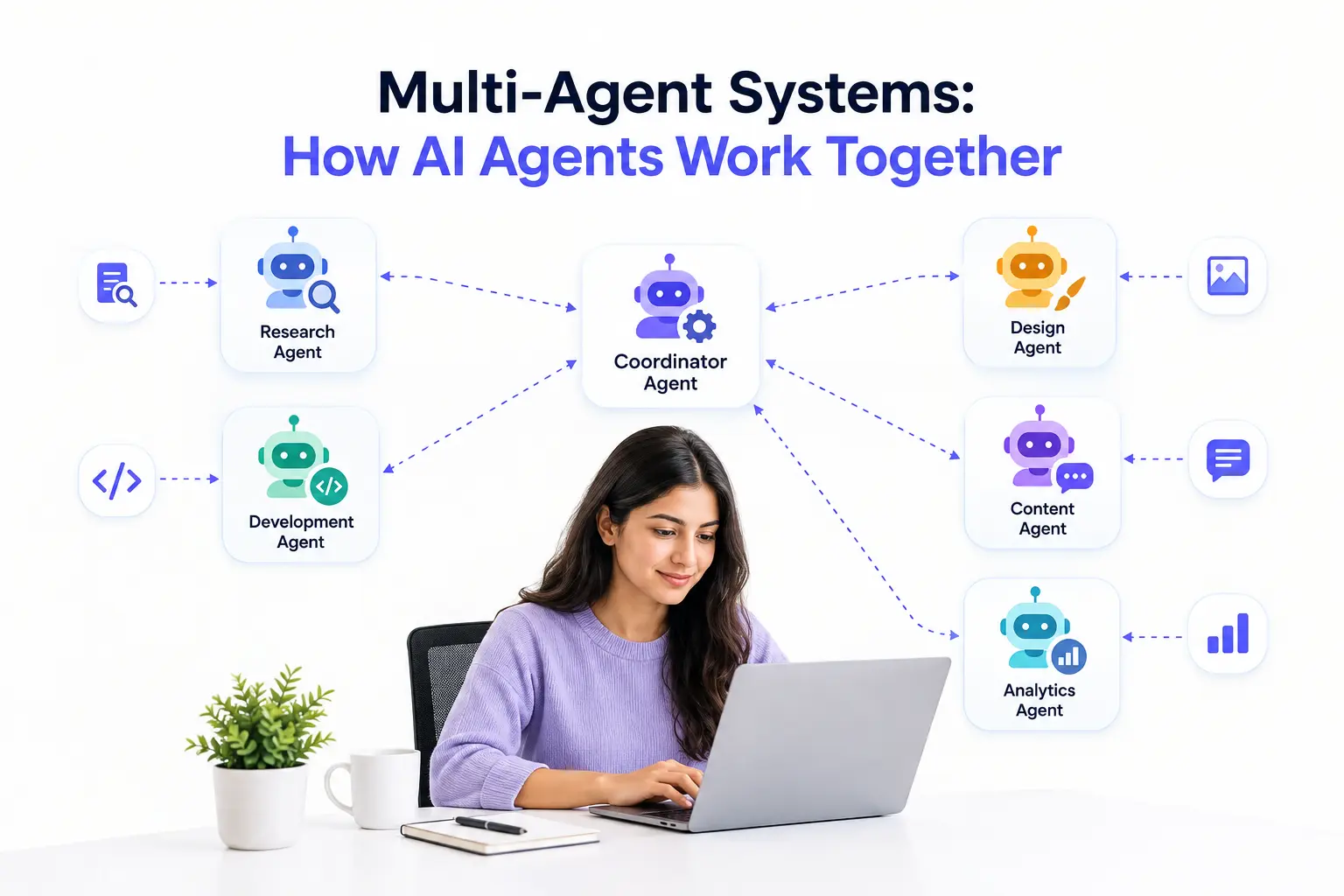
Multi-Agent Systems: How AI Agents Work Together
How multi-agent systems let specialized AI agents work together to handle complex tasks, automate workflows, and support smarter business operations.
Saturncube
15 September 2026
Artificial intelligence is moving beyond systems that simply answer questions or generate content. Modern AI applications can be designed to plan tasks, use tools, retrieve information, interact with software, and complete multiple steps toward a defined objective. When a complex task is divided among multiple specialized AI agents that communicate or coordinate with each other, the result is known as a multi-agent system.
A multi-agent system can combine several AI agents, each responsible for a particular role, under an orchestration layer that manages how work moves between them. For example, one agent might research information, another might analyze the findings, and a third might prepare an output or execute an action through an API. This approach can be useful when a business workflow is too complex for a single agent to handle effectively. SaturnCube's documented AI capabilities include multi-agent systems, autonomous workflows, task planning, knowledge retrieval, API connectivity, tool usage, and human-in-the-loop controls.
What Are Multi-Agent Systems?
A multi-agent system is an AI architecture in which multiple specialized agents work together to complete a broader task or workflow. Instead of giving one AI agent responsibility for every step, the system can assign different responsibilities to different agents based on their capabilities, tools, access permissions, or objectives.
Consider a business research workflow. A research agent could gather information from approved sources, an analysis agent could evaluate the information, a knowledge agent could retrieve relevant internal documents, and a reporting agent could organize the final findings. An orchestration layer determines which agent should work next and what information should be passed between them. This creates a structured workflow where each agent has a defined role rather than expecting one general-purpose agent to perform every task.

How Do Multi-Agent Systems Work?
The basic idea behind a multi-agent system is specialization plus coordination. Each agent receives a specific responsibility, the tools required for that responsibility, and access to the information it needs. The agents then communicate through an orchestration mechanism that controls the sequence of actions and determines when a task should move from one agent to another.
A typical workflow may begin with a user request or business event. A planning agent breaks the objective into smaller tasks, then assigns those tasks to specialized agents. A research agent might collect information, while another agent retrieves data from a knowledge base and another interacts with an external business application through an API. Once the individual tasks are completed, the system can combine the outputs and either produce a final response or continue with another action.
A simplified multi-agent workflow
User Request → Planning Agent → Specialized Agents → Tool/API Actions → Validation → Final Result
The architecture can become more sophisticated depending on the application. Agents may have access to memory, knowledge bases, APIs, databases, workflow tools, or human approval steps. SaturnCube's documented agent capabilities include memory systems, multi-step reasoning, knowledge-base access, API connectivity, workflow execution, and human-in-the-loop controls.
Single AI Agent vs Multi-Agent System
A single AI agent can be sufficient when the task has a relatively straightforward objective and does not require many specialized capabilities. For example, an internal assistant that retrieves information from a knowledge base and answers employee questions may not need several independent agents.
A multi-agent system becomes more useful when the workflow contains several distinct responsibilities. If a process requires research, analysis, decision-making, access to different tools, data retrieval, and execution, separating those responsibilities can make the architecture easier to organize. The key is not to use multiple agents simply because the technology allows it. A well-designed single agent can sometimes be simpler, cheaper, and easier to control than a multi-agent architecture.
The right architecture should therefore be determined by the business workflow and technical requirements, not by the number of agents that can be added to the system.
What Are the Main Components of a Multi-Agent Architecture?
A multi-agent architecture normally contains several important components that work together.
1. AI Agents
Each agent is responsible for a specific task or role. Depending on the application, an agent could act as a research assistant, customer support agent, sales assistant, operations agent, or internal knowledge agent. SaturnCube's documented AI agent types include customer support, sales, research, internal knowledge, HR, and operations agents.
2. Orchestration Layer
The orchestration layer controls how agents interact and how tasks move through the system. It can determine which agent should receive a task, what information should be passed forward, and when the workflow should continue, stop, or request human intervention.
3. Tools and APIs
Agents become more useful when they can interact with external systems rather than only generating text. Depending on the application, tools may allow an agent to retrieve information, call APIs, interact with databases, or execute actions inside existing business software. Tool calling, function calling, API integration, and database interaction are already part of SaturnCube's documented AI capabilities.
4. Knowledge and Retrieval
Agents may need access to company documents, databases, product information, policies, or other business knowledge. Retrieval systems can provide relevant information to an agent at the point when it is needed instead of relying only on information contained within the language model.
5. Memory and Context
Some workflows require agents to maintain context across multiple steps. Memory systems can help an application preserve relevant information during a task or across interactions, depending on the architecture and privacy requirements.
6. Human Oversight
Not every decision should be completely autonomous. A human-in-the-loop layer can require approval before sensitive actions are executed. This is particularly useful when an AI system can modify records, send communications, approve transactions, or perform other consequential operations.
Multi-Agent System Architecture
A practical multi-agent architecture can look like this:

The exact architecture depends on the workflow. Some systems use a central orchestrator that controls every agent, while others allow agents to communicate more dynamically. In production environments, the design also needs to account for permissions, failure handling, evaluation, observability, data access, and cost.
For businesses considering this architecture, it is important to define the workflow first and select the multi-agent pattern afterward.
Common Use Cases for Multi-Agent AI
Multi-agent systems are particularly relevant to workflows where several different types of work need to happen together.
Customer Support
One agent can classify a customer request, another can retrieve relevant information from a knowledge base, and another can prepare a response or initiate an approved action in the support system.
Sales Operations
A multi-agent workflow can support lead qualification, information gathering, customer research, CRM interaction, and follow-up preparation. Different agents can handle different stages while an orchestration layer manages the overall process.
Research and Analysis
A research agent can gather information while analysis agents evaluate different parts of the collected data. A final agent can organize the findings into a structured report.
Human Resources
Agents can support candidate screening workflows, information extraction, scheduling, and administrative tasks. Human review can remain part of the process for decisions that require professional judgment.
Internal Knowledge Management
A knowledge agent can retrieve information from approved company sources while another agent handles the user's request or performs a related workflow. This can be particularly useful when employees need information from multiple internal systems.
Business Operations
Multi-agent workflows can coordinate repetitive operational processes involving several systems, databases, or approval stages. SaturnCube's documented AI workflow automation examples include lead processing, customer support, HR automation, internal operations, and reporting automation.
Multi-Agent Systems and RAG
Multi-agent systems and Retrieval-Augmented Generation (RAG) solve different problems, but they can work together.
RAG gives an AI application a way to retrieve relevant information from an external knowledge source and use that information when generating a response. A multi-agent system, on the other hand, provides a way to divide and coordinate complex tasks among multiple agents.
For example, an enterprise AI application could use a planning agent to understand a request, a retrieval agent to find relevant internal documents, an analysis agent to evaluate the retrieved information, and a response agent to prepare the final answer. This combination can be useful when an AI workflow requires both access to business knowledge and multiple stages of reasoning or execution.
Read more: Agentic AI vs AI Agents
When Should a Business Use a Multi-Agent System?
A multi-agent architecture makes sense when a business workflow contains multiple distinct responsibilities that benefit from specialization. It can be particularly useful when different tasks require different tools, data sources, permissions, reasoning patterns, or validation steps.
For example, if an AI application needs to research information, retrieve internal documents, analyze data, interact with a CRM, and request approval before completing an action, dividing the workflow into specialized agents may create a more structured architecture.
However, multi-agent systems should not automatically be considered better than single-agent systems. Each additional agent introduces more orchestration, communication, evaluation, monitoring, and infrastructure requirements. If one agent can reliably perform the required workflow with the necessary tools and controls, a simpler architecture may be the better choice.
The best approach is to start with the business objective, map the workflow, identify where specialization is actually useful, and then decide whether a single-agent or multi-agent architecture is appropriate.

Benefits of Multi-Agent Systems
The biggest advantage of multi-agent systems is the ability to divide complex workflows into clearly defined responsibilities. Instead of building one large agent that needs to understand every part of a business process, developers can create specialized agents with narrower objectives and controlled access to tools or information.
This architecture can also make complex workflows easier to extend. A new capability can sometimes be introduced through an additional specialized agent rather than redesigning the entire system. At the same time, the system can incorporate human approval where necessary, giving businesses a way to combine automation with operational oversight.
Other potential benefits include:
The actual benefits depend on how the system is designed and the workflow it is intended to automate.
Challenges of Multi-Agent AI Systems
Building a multi-agent system is more complicated than connecting several AI models together. The agents need clearly defined responsibilities, reliable communication, appropriate tool access, and mechanisms for handling failures.
One challenge is coordination. If an agent produces an incorrect result or passes incomplete information to the next agent, the problem can propagate through the workflow. Another challenge is evaluation because the complete system needs to be tested at both the individual-agent level and the workflow level.
Security and permissions are also important. An agent that can access a CRM, database, financial system, or internal documents should only receive the permissions necessary for its role. Human approval may be required before certain actions are executed.
Cost and latency should also be considered. Multiple agents may involve additional model calls, retrieval operations, tool calls, and validation steps. A multi-agent architecture therefore needs to be designed around the required business outcome rather than simply maximizing the number of autonomous components.
Read more: How to build AI agents
How to Build a Multi-Agent System
A practical implementation can be divided into several stages.
Step 1: Define the Business Objective
Start by identifying the business problem rather than selecting an AI framework. Define what the system needs to accomplish and what actions it should or should not perform.
Step 2: Map the Workflow
Break the process into individual tasks. Identify which tasks require reasoning, data retrieval, tool access, human approval, or deterministic business logic.
Step 3: Decide the Agent Roles
Only create separate agents where specialization provides a clear advantage. Give each agent a well-defined responsibility and establish what information and tools it can access.
Step 4: Design the Orchestration
Determine how agents communicate, how tasks are assigned, how information is transferred, and what happens when an agent fails or produces an uncertain result.
Step 5: Connect Knowledge and Tools
Add approved knowledge sources, databases, APIs, business applications, and other tools required by the workflow. SaturnCube's AI stack includes LangChain, LangGraph, LlamaIndex, CrewAI, AutoGen, OpenAI, Claude, Gemini, Pinecone, Weaviate, Chroma, and MCP among its documented technologies.
Step 6: Add Controls and Evaluation
Define permissions, validation rules, human approval points, logging, and evaluation criteria before moving the system into production.
Step 7: Deploy and Improve
Monitor the workflow after deployment. Evaluate agent outputs, identify failure patterns, refine prompts and workflows, and adjust the architecture as business requirements evolve.
Multi-Agent AI Technology Stack
There is no single framework that is best for every multi-agent system. The technology should be selected according to the workflow, integrations, data requirements, model choices, and deployment environment.
SaturnCube's documented AI technology stack includes LangGraph, CrewAI, AutoGen, OpenAI Agents SDK, Semantic Kernel, LangChain, LlamaIndex, OpenAI, Claude, Gemini, Pinecone, Weaviate, Chroma, PyTorch, TensorFlow, Hugging Face, AWS SageMaker, Google Vertex AI, MLflow, Docker, Kubernetes, FastAPI, and MCP.
For a particular project, the important question is not simply which framework is trending. The better question is which combination of models, orchestration tools, retrieval systems, APIs, infrastructure, and controls can reliably support the required workflow. AI software development Once the dedicated service page is published, this article should link to it naturally in this section and again near the conclusion.
Multi-Agent Systems vs AI Agents: What's the Difference?
An AI agent is an autonomous or semi-autonomous software component that can reason about a task, use tools, retrieve information, and take actions based on its design.
A multi-agent system uses multiple such agents within a coordinated architecture. Each agent can have a different responsibility, while an orchestration mechanism manages how the overall task progresses.
In simple terms:
AI Agent: One intelligent worker handling a task.
Multi-Agent System: Multiple specialized AI workers collaborating on a larger workflow.
The important distinction is architectural. A multi-agent system is not automatically more intelligent simply because it contains more agents. Its value comes from dividing responsibilities in a way that makes a complex workflow easier to manage, control, and execute.
Are Multi-Agent Systems the Future of Business Automation?
Multi-agent systems have strong potential for business automation because many real-world processes are not single-step tasks. They involve information gathering, decisions, system interactions, approvals, and follow-up actions. An architecture that can coordinate specialized AI agents can therefore be useful for workflows that require several connected capabilities.
At the same time, businesses should avoid treating multi-agent AI as a solution for every automation problem. Traditional automation, deterministic workflows, a single AI agent, agentic RAG, or a combination of these approaches may be more appropriate depending on the use case.
The most effective AI systems are usually designed around the actual business process. Multi-agent architecture becomes valuable when specialization, coordination, tool usage, and multi-step execution provide a meaningful advantage.
Final Thoughts
Multi-agent systems provide a way to build AI applications that can handle complex workflows through multiple specialized agents rather than relying on one general-purpose agent for every task. With the right architecture, agents can coordinate research, knowledge retrieval, analysis, API interactions, workflow execution, and human approval as part of a connected process.
For businesses considering multi-agent AI, the starting point should always be the workflow. Define the business objective, understand the individual tasks, identify where AI can provide value, and then determine whether a single-agent or multi-agent architecture is appropriate. The technology should support the business process, not the other way around.
SaturnCube's AI capabilities include multi-agent systems, autonomous workflows, task planning, knowledge retrieval, API integration, tool usage, memory, workflow execution, and human-in-the-loop controls, providing a foundation for developing AI systems around specific business workflows.