


N8n Workflow Automation Guide
How n8n helps businesses automate workflows, connect apps, build AI-powered systems, and improve operational efficiency with scalable automation.
Gaurang Mistry
29 May 2026
Businesses today rely on dozens of digital tools to manage daily operations. From CRM systems and marketing platforms to databases and communication tools, modern companies constantly move data between different applications. While these systems improve productivity, they also create repetitive manual work that consumes valuable time.
This is one of the main reasons workflow automation platforms are becoming essential for modern businesses. Among these platforms, n8n has quickly gained attention because of its flexibility, scalability, and strong integration capabilities.
Many growing companies, startups, and enterprise teams now use n8n to automate repetitive tasks, connect systems, and build intelligent workflows that improve operational efficiency. As automation and artificial intelligence continue evolving together, tools like n8n are becoming an important part of digital transformation strategies.
At Saturncube Technologies, we closely follow modern automation trends because businesses today need scalable systems that reduce operational complexity while improving productivity. For more complex automation, consider custom AI agents. Need help implementing n8n? Hire our Node.js developers.
What is n8n?
n8n is an open-source workflow automation platform designed to help businesses connect different apps, APIs, databases, and software tools into one automated system. Instead of handling repetitive operational tasks manually, businesses can create workflows that automatically move data, trigger actions, and manage processes across multiple platforms. This helps teams save time, reduce operational effort, and improve overall efficiency.

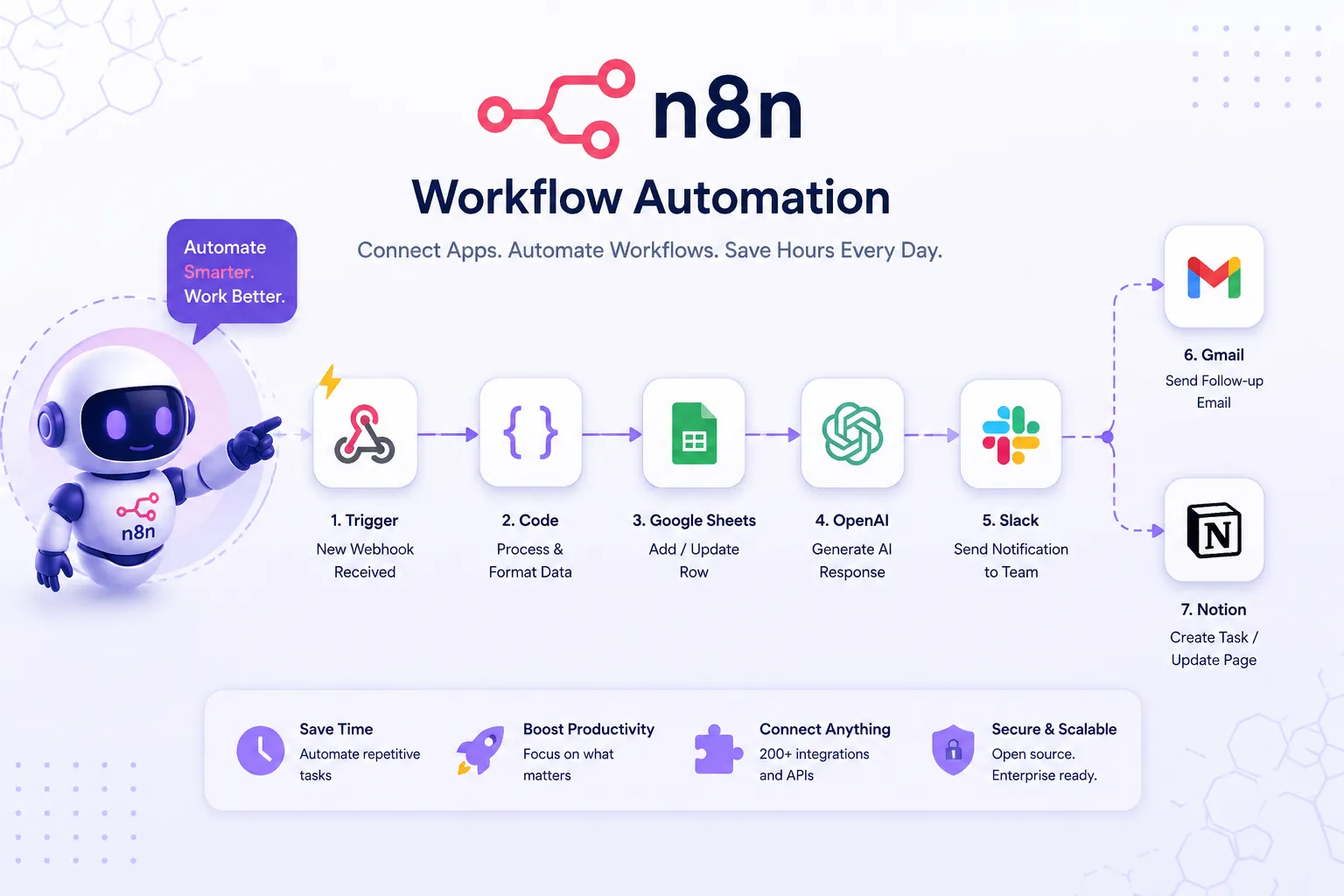
In simple terms, n8n acts like a bridge between different business tools. For example, when a customer submits a contact form on a website, n8n can automatically capture the data, send it to a CRM, notify the sales team on Slack, trigger a follow-up email, and store the information inside a database at the same time. Without workflow automation, these tasks would normally require manual coordination between multiple tools and team members.
One of the biggest reasons behind n8n’s growing popularity is its flexibility and scalability. Unlike many traditional automation platforms that focus only on simple no-code workflows, n8n also supports advanced custom logic, API integrations, and developer-level customization. This makes it suitable for startups, SaaS companies, agencies, and enterprise businesses that need powerful automation systems capable of handling modern operational and AI-driven workflows.
Why Workflow Automation is Growing Rapidly
Modern businesses generate massive amounts of operational data every day. Marketing teams manage leads, support teams handle customer inquiries, developers monitor systems, and sales teams process communication across multiple platforms.
Managing these processes manually slows operations and increases the chances of errors.
Workflow automation helps solve these challenges by creating systems that run automatically in the background. Businesses are now automating repetitive operations to improve speed, accuracy, and scalability.
Some common automation goals include:
As businesses scale, automation becomes less of a convenience and more of a requirement.
This growing demand is also increasing interest in technologies like AI automation, where businesses combine workflow systems with artificial intelligence to create smarter operational processes.
How n8n Works
n8n works through automated workflows, where different tasks are connected together and executed automatically after a trigger event occurs. Instead of manually handling repetitive operations across multiple tools, businesses can create workflows that automatically move data, send notifications, update records, and perform actions based on predefined conditions.
For example, when a customer submits a contact form on a website, n8n can instantly capture the information and automatically perform multiple actions such as:
Inside n8n, every task is managed using nodes, which act as the building blocks of workflows. Each node performs a specific action like connecting APIs, processing data, applying conditions, or updating systems. This flexible structure allows businesses to build simple automations as well as advanced AI-powered workflows based on their operational needs.
Understanding Nodes in n8n
Nodes are the core building blocks of every workflow in n8n. Different nodes perform different tasks depending on workflow requirements.
For example, one node may connect with Gmail, another with Google Sheets, and another with OpenAI APIs.
There are generally three major types of nodes used in workflows.
Node Type | Purpose |
|---|---|
Trigger Nodes | Start workflows when an event occurs |
Action Nodes | Perform tasks like sending data or creating records |
Logic Nodes | Apply filters, conditions, loops, and routing |
This combination allows businesses to create workflows ranging from simple automations to highly advanced backend operational systems.
One of the biggest reasons developers prefer n8n is because it supports custom APIs and advanced integrations. Even if a platform does not have a direct integration, workflows can still connect using API requests and custom logic.

Real-World Use Cases of n8n
n8n is now being used across multiple industries because almost every business contains repetitive processes that can be automated.
Marketing teams often use workflows to manage leads, automate email sequences, generate reports, schedule content, and organize campaign data. Instead of manually transferring information between systems, workflows handle these operations automatically.
Customer support teams use automation for ticket creation, instant notifications, inquiry routing, and AI-powered response systems. This improves response speed while reducing manual workload.
Development teams frequently use n8n for backend operations such as API synchronization, server monitoring, deployment notifications, and database updates.
E-commerce businesses also rely heavily on workflow automation for order processing, payment confirmations, inventory synchronization, customer notifications, and shipping updates.
As operational complexity grows, workflow automation helps businesses maintain efficiency without continuously increasing manpower.
Our main service: Web Development
n8n and AI-Powered Automation
One of the strongest reasons behind n8n’s popularity is its compatibility with modern AI systems.
Businesses are now moving beyond traditional automation and exploring intelligent workflows powered by artificial intelligence. Instead of only automating repetitive tasks, companies are building systems capable of analyzing information, generating responses, and assisting decision-making processes.
n8n integrates effectively with technologies such as:
This enables businesses to build advanced systems that automate customer interactions, content generation, document processing, and operational workflows.
For example, an AI-powered workflow can automatically receive a customer question, search a knowledge base, generate a response using AI, and send the answer back instantly.
This combination of automation and artificial intelligence is becoming a major focus area for businesses investing in AI software development services.
Companies exploring intelligent workflow systems are also increasingly adopting technologies related to AI agents to improve automation capabilities across customer support, operations, and internal business processes.
n8n vs Zapier
Zapier is one of the most well-known automation platforms, so comparisons between Zapier and n8n are common.
While both tools automate workflows, they serve slightly different business requirements.
Feature | n8n | Zapier |
|---|---|---|
Open-source | Yes | No |
Self-hosting | Available | Not available |
Advanced customization | High | Moderate |
Developer flexibility | Strong | Limited |
AI workflow capability | Advanced | Moderate |
Pricing scalability | Better for large workflows | Expensive at scale |
Zapier is often preferred for simple beginner-friendly automations. n8n, however, is usually favored by developers and growing businesses that require scalability, advanced integrations, and deeper customization.
The ability to self-host workflows also makes n8n attractive for businesses that prioritize privacy and infrastructure control.
Benefits of

One of the biggest benefits of using n8n is improved operational efficiency. Businesses can automate repetitive tasks like lead management, notifications, data transfers, and follow-up emails, helping teams save time and focus on more important work.
n8n also improves accuracy because workflows follow predefined rules and conditions automatically. This reduces manual errors, missed updates, and communication delays, especially when handling customer data or operational processes across multiple platforms.
Another major advantage is flexibility and scalability. Since n8n supports APIs, databases, cloud platforms, and AI integrations, businesses can build automation systems that grow alongside their operations and support long-term digital scalability.
Is n8n Suitable for Non-Technical Users?
n8n includes a visual drag-and-drop interface that makes workflow creation much easier for non-technical users. Simple automations such as sending notifications, updating spreadsheets, capturing leads, or connecting common business tools can often be created without advanced programming knowledge. This makes the platform beginner-friendly for startups, marketing teams, and small businesses that want to automate repetitive tasks quickly.
However, as workflows become more advanced, technical knowledge may still be required. Complex systems involving APIs, authentication methods, custom integrations, databases, conditional logic, and AI workflows often need a deeper understanding of how automation systems work. Businesses building large-scale operational workflows usually require proper planning, workflow architecture, and scalability management to ensure everything runs efficiently.
This is one reason many organizations collaborate with automation specialists or experienced development teams when implementing enterprise-level workflow systems. Teams with expertise in automation, APIs, and AI integration can help businesses create scalable solutions tailored to their operational goals. Companies looking to build advanced automation systems can also contact our team to explore customized workflow automation and AI implementation strategies.
Our service Mobile App Development
The Future of Workflow Automation
Workflow automation is evolving rapidly alongside artificial intelligence, and businesses are now moving beyond simple task automation toward smarter operational systems. Instead of only automating repetitive work, modern workflows are becoming capable of analyzing data, making decisions, triggering intelligent responses, and managing complex business operations with minimal manual involvement.
The future of automation will include AI-powered workflows, autonomous agents, predictive systems, and highly connected digital ecosystems. Platforms like n8n are becoming increasingly important because they help businesses integrate APIs, cloud platforms, databases, and AI tools into a single scalable automation layer. This allows organizations to build faster, smarter, and more efficient operational systems.
As digital transformation continues across industries, workflow automation will likely become a standard business requirement rather than an optional productivity tool. Companies that adopt scalable automation systems early often gain long-term advantages in operational efficiency, customer experience, and business scalability.
Frequently Asked Questions
What is n8n used for?
n8n is a workflow automation platform that helps businesses connect apps, APIs, databases, and software tools to automate repetitive tasks. It is commonly used for lead management, CRM updates, notifications, data synchronization, reporting, and AI-powered workflows.
Is n8n better than Zapier?
Both platforms are powerful, but they serve different needs. Zapier is often preferred for simple no-code automations, while n8n offers greater flexibility, self-hosting options, advanced customization, and stronger support for complex workflows and AI integrations.
Can n8n be used with AI tools like OpenAI?
Yes. n8n integrates with OpenAI, LangChain, vector databases, AI agents, and other AI technologies. Businesses can use these integrations to build intelligent workflows for customer support, content generation, document processing, and automated decision-making.
Does n8n require coding knowledge?
Basic workflows can be created using n8n's visual drag-and-drop interface without coding. However, advanced workflows involving APIs, custom integrations, databases, and AI systems may require technical knowledge or support from experienced developers.
Can n8n be self-hosted?
Yes. One of n8n's biggest advantages is that it is open-source and supports self-hosting. This gives businesses greater control over their data, security, infrastructure, and workflow management.
What types of businesses can benefit from n8n?
n8n is suitable for startups, SaaS companies, agencies, e-commerce businesses, and enterprise organizations. Any business that wants to automate repetitive processes, improve efficiency, and connect multiple systems can benefit from workflow automation using n8n.
Final Thoughts
n8n has emerged as one of the most flexible and powerful workflow automation platforms available today. Its open-source architecture, advanced integrations, scalability, and AI compatibility make it highly valuable for modern businesses.
Whether companies want to automate lead management, streamline internal operations, connect multiple software systems, or build intelligent AI workflows, n8n provides a strong foundation for scalable automation.
As automation technologies continue evolving, businesses that invest in modern workflow systems will be better positioned to improve operational efficiency and adapt to future digital demands.
Ready to Build Your AI Agent?
Our AI development team has built 50+ AI agents for businesses across healthcare, e-commerce, and SaaS. From concept to deployment, we handle everything.